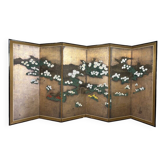
Antique Japanese six-panel screen with box – Japan, circa 1900

- Dimensions :
- H168 x W353 x D1
- Color :
- multicolour
- Material :
- paper
- Style :
- world's craft
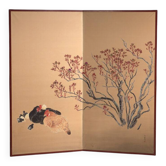
This ancient Japanese six-panel screen is a byōbu painted on paper with its wooden storage box. It originates from Japan, from the late Meiji period, when the screen articulated the space of the home and was kept in its own box. The byōbu was used as a separator and as a backdrop in the Japanese home, folding for storage. Keeping the original wooden box for transport and protection reflects the care it has received over time. The six panels are made of paper mounted on wooden frames, joined by paper hinges that allow them to fold in a zigzag manner, with a lacquered frame and a patterned paper back. The painting unfolds continuously across the panels. The composition depicts water birds—ducks and a heron—amidst chrysanthemums and bamboo, in ink and colour on aged paper, with the calligraphy and seal of the artist. The chrysanthemum (kiku) symbolises longevity, and the water birds evoke water and the passage of seasons. With its horizontal development, it serves as a space divider, headboard, or backdrop in a large room. It integrates into wabi-sabi, japandi, and eclectic interiors, where it adds depth and narrative. Details. Dimensions: Length 353 cm – Depth 1 cm – Height 168 cm. Style: Traditional Japanese. Materials and techniques: Paper painted on wooden frames; paper hinges; lacquered frame; wooden box. Place of origin: Japan. Period: Meiji period. Date of manufacture: Circa 1900. Condition / Observations: Good. Screen with wooden storage and transport box; shows water stains, knocks, and missing pieces. Folded dimensions: Length 64 cm – Depth 30 cm – Height 177 cm. Box dimensions: Length 28 cm – Depth 66 cm – Height 176 cm. Wear consistent with age and use.