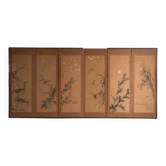
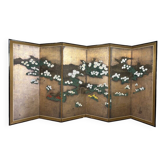
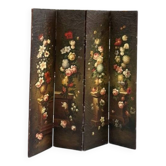
Ancient Japanese folding screen with two panels on a gold background – Japan, circa 1920

- Dimensions :
- H172 x W180 x D2
- Color :
- golden
- Material :
- paper
- Style :
- world's craft
This ancient Japanese two-panel screen is a byōbu painted on a gold background with a lacquered frame. It originates from Japan, from the Taishō period, when the two-panel screen served as a backdrop and divider in the home. The two-panel byōbu was placed behind a seat, near an entrance, or as the background of a composition, and could be folded for storage. The gold background positioned it as a piece of certain prestige. The two panels are made of paper mounted on a wooden frame, joined by paper hinges, with a red lacquered frame and a patterned paper back. The painting occupies the continuous surface of both panels. The composition depicts a flowering tree and a pair of poultry against a gold background, in colour on paper, with the artist's signature and seal. The gold background enhances the motif and brings light to the scene. With its two-panel format, it serves as a decorative backdrop, a temporary divider, or a wall piece. It integrates into wabi-sabi, japandi, and eclectic interiors, where it adds warmth and a golden accent. Details. Dimensions: Length 180 cm – Depth 2 cm – Height 172 cm. Style: Traditional Japanese. Materials and techniques: Painted paper on a gold background on a wooden frame; paper hinges; red lacquered frame. Place of origin: Japan. Period: Taishō period. Date of manufacture: Circa 1920. Condition / Observations: Good. Patina and age-related marks on the paper and frame. Folded dimensions: Length 90 cm – Depth 4 cm – Height 172 cm. Wear consistent with age and use.
5 ()