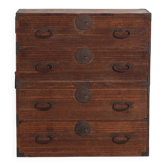
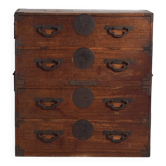
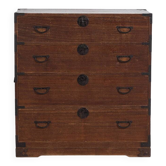
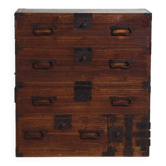
Ancient Japanese Tansu – Meiji/Taishō Period (c. 1890-1926) #57

- Dimensions :
- H107 x W98 x D45
- Color :
- wooden
- Material :
- wood
- Style :
- world's craft
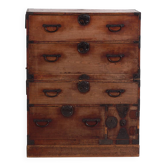
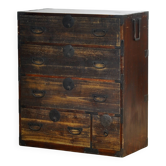
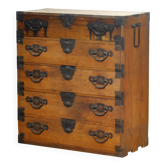
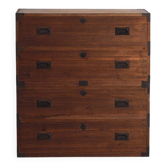
Antique Japanese Tansu – Meiji/Taishō Period (c. 1890-1926) Dimensions: Length: 98 cm Depth: 45 cm Height: 107 cm. Style: Meiji. Materials and Techniques: Paulownia (Paulownia spp.) Place of Origin: Japan. Era: End of the Meiji period, beginning of the Taishō period. Date of Manufacture: Circa 1890-1926. Condition: Good. Wear is consistent with age and use. Original Meiji period Japanese tansu, in a vertical format with generous proportions, designed as a high-capacity domestic storage piece. The composition is rich and asymmetrical, combining wide drawers, smaller side drawers, closed compartments, and interior shelves, organised according to a strictly functional logic. The piece is entirely made of paulownia wood (Paulownia spp.), a lightweight and stable species widely used in Japanese furniture for its natural resistance to moisture and durability. The interiors of the drawers retain the characteristic light hue of paulownia, while the exterior surfaces exhibit a warm, deep patina acquired over time. The original wrought iron fittings — circular plates, handles, side transport grips, and corner reinforcements — structure the façade and highlight both the solidity and the graphic and architectural character of the whole. Their ancient and regular oxidation is fully consistent with the period. The Meiji period (1868–1912) marks a profound transformation in Japanese society, during which traditional craft techniques adapted to new forms of domestic organisation. Tansu from this era are distinguished by their modularity, robustness, and a rational design for storage. The use of paulownia reflects a material culture based on lightness, mobility, and durability, essential in the daily life of late 19th-century Japan. UNIQUE PIECE.
5 ()