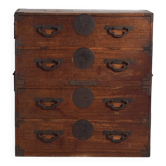
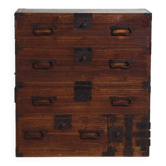
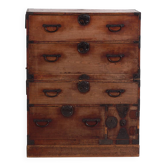
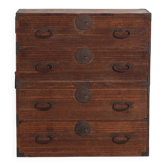
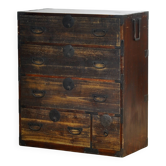
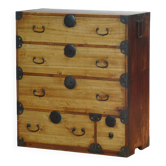
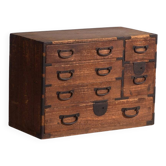
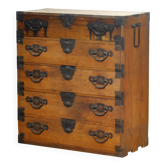
Old Japanese chest of drawers – Meiji / Taishō period (c.1868-1926) #43

- Dimensions :
- H99 x W84 x D44
- Color :
- brown
- Material :
- wood
- Style :
- world's craft
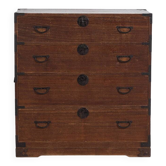
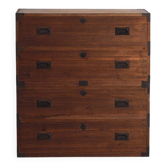
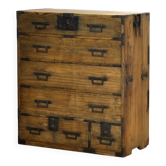
Antique Japanese Commode – Meiji / Taishō Period (c.1868-1926) Dimensions: Length: 84 cm Depth: 44 cm Height: 99 cm. Style: Meiji. Materials and Techniques: Paulownia (Paulownia spp.) Place of Origin: Japan. Period: Late Meiji period, early Taishō period. Date of Manufacture: Circa 1868-1926. Condition: Good. Wear is consistent with age and use. Original Japanese tansu from the Meiji period, in a vertical format with compact and balanced proportions, designed as a functional domestic storage piece. The composition is organised around four wide drawers that highlight its practical and architectural character. The piece is entirely made of paulownia (Paulownia spp.), a lightweight and stable wood particularly valued in Japanese furniture for its resistance to moisture and dimensional variations. This material allows for a construction that is both robust and light, suitable for durable domestic use. The façade features original iron fittings, including recessed handles, circular closing plates, and corner reinforcements. These elements ensure the solidity of the structure while creating a subtle graphic contrast with the warm hue of the wood. The surface retains a deep and irregular patina, marked by signs of use, scratches, and softened edges, reflecting several decades of use and enhancing its wabi-sabi aesthetic. The Meiji period (1868–1912) corresponds to a major transformation in Japanese society, during which traditional artisanal techniques adapted to new forms of domestic organisation. Furniture from this era is characterised by its modularity, durability, and a rational design for storage. The use of paulownia reflects a material culture based on lightness, mobility, and longevity, essential in the daily life of late 19th-century Japan. UNIQUE PIECE.
5 ()