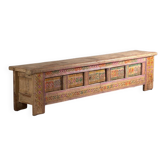
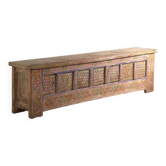
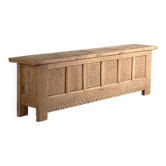
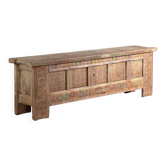
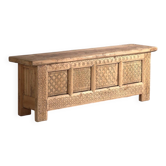
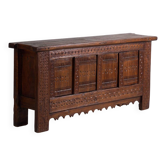
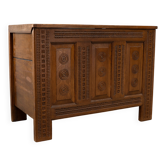
Antique polychrome carved low cabinet in pine – Xinjiang, circa 1900

- Dimensions :
- H64 x W272 x D45
- Color :
- multicolour
- Material :
- wood
- Style :
- design
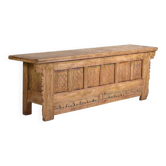
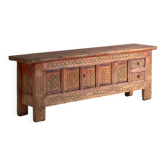
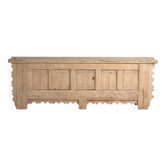
This antique low cabinet, intricately carved and polychrome in pine, is a Uyghur piece from Xinjiang featuring eight carved panels and posts with a cut profile. It originates from Xinjiang in north-west China, from the Qing dynasty, where pine carving was covered with pigment applied with a brush. Such furniture occupied an entire wall of the reception room and organised domestic life horizontally, at the height of the low platform where people ate and slept. The case is made of solid pine, assembled with mortise and tenon joints. Five of these panels open as doors to independent compartments; the others are fixed. The outer posts are cut in waves and extend into bracket feet; the back is closed with vertical boards. The eight panels alternate between lattice of four leaves and broken arches inscribed, a profile borrowed from the local architectural bay. The upper and lower friezes replicate the lattice on a smaller scale, and the mouldings are highlighted in violet blue. The palette combines pink, green, yellow, orange, and purple; the outer posts feature their cut painted in coral red. The pigment has lost its body and has faded to a very soft pastel range. The top is bare, with open joints and signs of use. Overall, there is a bright front face and a clean wood structure, without finish. Details. Dimensions: Length 272 cm – Depth 45 cm – Height 64 cm. Style: Uyghur from Xinjiang. Materials and techniques: Pine wood; mortise and tenon assembly; bas-relief carving and polychromy with pigment. Place of origin: China, Xinjiang. Period: Qing dynasty. Date of manufacture: Circa 1900. Condition / Observations: Good. Original polychromy faded to pastel tones, open joints on the top and signs of use. Wear consistent with age and use.
5 ()
Cupboards & buffets: other similar vintage pieces
Discover more similar items- -12%
- Sold out
- -9%