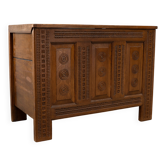
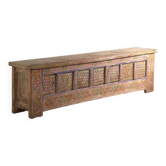
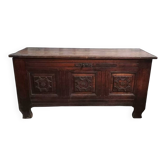
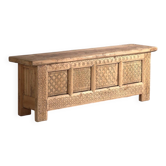
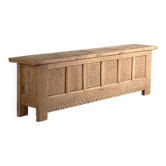
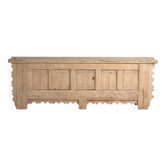
Antique carved pine wood buffet – Xinjiang, circa 1900

- Dimensions :
- H85 x W183 x D42
- Color :
- brown
- Material :
- wood
- Style :
- vintage
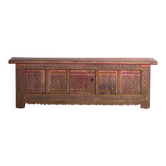
This antique carved pine sideboard is a Uyghur piece from Xinjiang with four carved doors and a lobed arc frieze. It originates from Xinjiang in north-west China, from the Qing dynasty, where pine was carved with a chisel and then protected with a dark stain. In the Uyghur home, the storage furniture was aligned against the wall of the reception room and held textiles, utensils, and valuables. The carving was not an added ornament but a way to ennoble a humble wood in a region where good timber was scarce. The case is made of solid pine, assembled with mortise and tenon joints. Four panel doors open in pairs. The uprights extend into bracket feet, and the lower frieze is cut into lobed arcs that echo the profile of local architecture. Each panel features a central band of rosettes with interlaced circles, framed at the top and bottom by short fluted friezes that read like dentils. The vertical uprights bear diamond latticework with petals, and the upper frieze repeats the motif on a smaller scale. Without polychromy: the relief is perceived through the contrast of shadow on the dark hue. The colour has darkened over time and gained a deep sheen on the most handled edges. The top shows open joints and wear typical of a continuously used piece of furniture. The patina is warm. Its sideboard height is suitable for an entrance, dining room, or hallway. The dense carving calls for a smooth wall and low light, the only moment when the relief gains depth. Details. Dimensions: Length 183 cm – Depth 42 cm – Height 85 cm. Style: Uyghur from Xinjiang. Materials and techniques: Pine wood; mortise and tenon assembly; bas-relief carving; original dark stain. Place of origin: China, Xinjiang. Period: Qing dynasty. Date of manufacture: Circa 1900. Condition / Observations: Good. Wear consistent with age and use.
5 ()