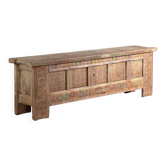
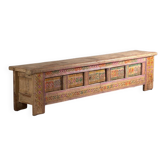
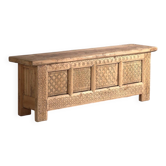
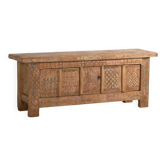
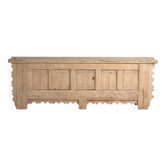
Antique polychrome carved low cabinet in pine – Xinjiang, circa 1900

- Dimensions :
- H67 x W255 x D44
- Color :
- brown
- Material :
- wood
- Style :
- classic
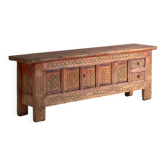
This antique low cabinet, intricately carved and polychrome in pine, is a Uyghur piece from Xinjiang featuring seven carved doors and openwork friezes. It originates from Xinjiang in north-west China, from the Qing dynasty, where pine carving was painted with a brush using ground pigments. With a width of 255 cm, this piece occupied an entire wall of the Uyghur reception room. The house was organised around the supa, the low platform where meals were eaten and sleeping took place, and the furniture was designed to match this height: long, low, and accessible from the ground. The case is made of solid pine, joined with mortise and tenon joints. Seven panel doors open to independent compartments, with forged iron rings serving as handles. The uprights extend into bracket feet, and the edge of the top features a chevron-carved moulding. The carving covers the doors, uprights, friezes, and plinth. The design includes a lattice of lanceolate petals in a diagonal pattern, bouquets of pointed leaves, and openwork friezes of small arches. The colours were applied in pink, emerald green, yellow, orange, and violet blue, the latter reserved for the mouldings; the plinth features a band of red and yellow leaves on a light background. Details. Dimensions: Length 255 cm – Depth 44 cm – Height 67 cm. Style: Uyghur from Xinjiang. Materials and techniques: Pine wood; forged iron fittings; mortise and tenon joinery; bas-relief carving and polychromy with pigment. Place of origin: China, Xinjiang. Period: Qing dynasty. Date of manufacture: Circa 1900. Condition / Observations: Good. Original carving and polychromy have significantly faded, with open joints on the top. Wear consistent with age and use.
5 ()
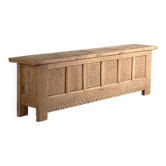
Credenzas & sideboards: other similar vintage pieces
Discover more similar items- -12%
- -15%
- -16%
- -9%