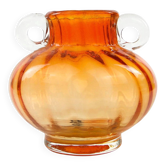
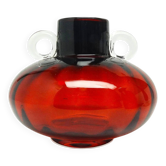
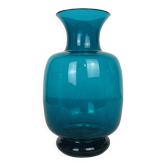
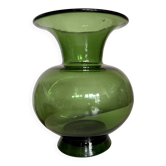
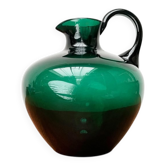
Mid-century modern vase, glass, designed by J. Słuczan-Orkusz, Poland, 1970s

- Dimensions :
- H14 x W13 x D13
- Color :
- multicolour
- Material :
- glass and crystal
- Style :
- mid-century
A vase designed by Jerzy Słuczan-Orkusz, made in the 1970s by the Krakow Glass Institute, is an example of Polish mid-century modern utility glass art. The vase features a classic amphora silhouette with a bulbous body, wide flared neck, and two perfectly round handles evenly placed on the sides. The colour is dominated by a gradient: transparent red smoothly transitions to an amber-orange hue at the base, creating intense reflections on the smooth, glossy glass surface. The body is free of additional decorations, highlighting the purity of the material and the fluidity of the lines. The proportions remain harmonious, with the handles and neck flowing smoothly into the main body. Condition is very good: no signs of use or damage, no repairs; the vase retains its original structure and colour, being an example of authentic Polish vintage craftsmanship. The character of this vase evokes the spirit of the 1970s: bold colours and thoughtful simplicity of form bring the optimism and creativity characteristic of Polish design of that era. The interpenetrating shades of red and orange tell the story of glass experiments conducted at the Krakow Glass Institute. The vase, though modest in detail, has a certain monumental calm: it is a record of craftsmanship that brings out both light and colour from the material. The handles, bent into circles, reflect the designer's fondness for universal, readable symbols of home warmth and friendly geometry. This glass form will work perfectly as a central point in a display, on a mid-century console, or in a more eclectic interior, where it can contrast with matte wood or fabric surfaces. It is worth combining it with other vessels from the era or minimalist decorations – for example, geometric ceramic plates or low lamps with a shiny shade. The vase can be a colour accent in both bright and deep, cosy arrangements; it gains exceptional qualities in natural light, which highlights the fluidity of the gradient and the gloss of the glass.
Vases: other similar vintage pieces
Discover more similar items- -15%
- -15%
- -15%
- -14%
- -15%
- -15%
- -15%
- -15%
- -15%