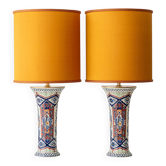
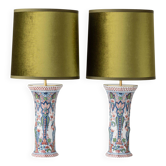
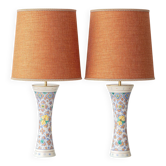
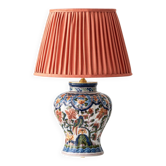
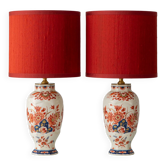
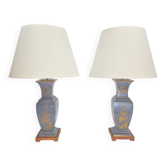
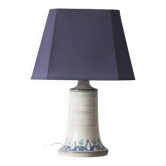
Vintage Belgian Delft Style Table Lamps by Boch with Brass Elements, 1950-1970, New Shades

- Dimensions :
- H61 x W30 x D30
- Color :
- multicolour
- Material :
- ceramics, porcelain and earthenware
- Style :
- vintage
This pair of Belgian Delft table lamps in a Chinoiserie style began as polychrome trumpet vases, circa 1950s–1970s, marked "Brugge Boch Belgium — Handworked" underneath. Transformed into lamps by Amitābha Studio, they have custom-cut brass fittings, are newly wired with fabric-wrapped cords, and are paired with new cream silk pleated lampshades. Plugs will be customized for your country of use. Height includes lampshades. The flared beaker or "trumpet" shape has a long pedigree. Dutch Delft potters lifted the design from the Chinese gu vase in the seventeenth century and set it on mantelpieces in garnitures, flanking covered jars. Belgian factories took up the form along with the painted vocabulary that came with it and kept both in production for generations, including this pair from postwar La Louvière. The surprise of this pair is the beautiful muted palette. Rather than the expected blue and white, the decoration runs in vertical panels of a deep blue laid over a terracotta brick red, with stylized blossoms, scrolling foliage, water and flowers worked in a delicate yellow and sage green. Diamond and zig-zag borders ring the flared rim and foot. It is a polychrome scheme with China and Japan in its ancestry, filtered through Dutch and then Belgian hands. The design is consistent across the pair, and the mark on the underside says "Handworked" in English — a small tell that these were finished for the export trade. The pair has a delightfully warm presence, especially with the new cream silk pleated shades which create a lovely light. About Boch Frères Keramis Boch Frères Keramis was established in 1841 in La Louvière, Belgium, by members of the Boch family, faïence makers long active across Lorraine and Saarland. By the late nineteenth century, Boch had become one of Belgium's leading ceramic producers, with a repertoire ranging from Art Nouveau and Art Deco artistic wares, notably under Charles Catteau in the 1920s.
Bedside and table lamps: other similar vintage pieces
Discover more similar items- -34%
- -12%
- -24%
- -12%
- Sold out
- -30%
- -14%
- -11%
- -38%