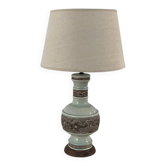
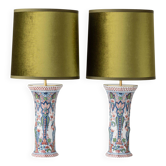
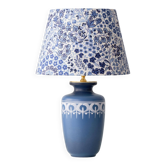
Vintage Royal Delft Ceramic Table Lamp, Rare Teal Delvert Glaze, New Lampshade

- Dimensions :
- H60 x W25 x D25
- Color :
- green
- Material :
- ceramics, porcelain and earthenware
- Style :
- vintage
A vintage Royal Delft (De Porceleyne Fles) ceramic table lamp in the rare teal Delvert glaze, 1970s, hand-painted and transformed into a lamp by Amitābha Studio with new brass fittings, new wiring with a pink fabric wrapped cord. U.S. plug or customized for your country of use. There are two new lampshade options! One is a peacock blue green Dupion silk, the other is a blush pink bespoke Liberty London jacquard shade with a subtle peacock feather textured print. Height includes lampshade. The base is an authentic Royal Delft vase from the Delvert series, hand-painted with stylized floral and geometric motifs in soft blue-green beneath the milky matte glaze that defines the line. The name joins Delft with vert, French for green. Designed by the Dutch painter Herman Sanders and introduced in 1968, Delvert was the factory's deliberate departure from its famous blue and white, and it proved difficult to make. So many pieces were lost in the kiln that production became too costly, and the line was discontinued around 1976. Far fewer examples survive than of classic Delft blue. The underside carries the De Porceleyne Fles factory mark and a year letter dating the piece. Amitābha Studio has converted the vase into a lamp non-invasively and paired it with a bespoke shade in Liberty London's Hera Plume jacquard in Slipper Pink. Hera, the peacock-feather design Liberty has made its own since the 1890s, is named for the Greek goddess whose emblem was the peacock. Its warm pink softens the cool glaze, and the peacock is a quiet nod to the blue-green of the vase. About Royal Delft De Porceleyne Fles, trading as Royal Delft, was founded in Delft in 1653 and is the only one of the city's original 17th-century Delftware potteries still in operation. Long famous for hand-painted blue-and-white earthenware in the Chinese-inspired manner, the factory has also produced experimental ranges across its history.
Bedside and table lamps: other similar vintage pieces
Discover more similar items- -42%
- -25%
- -11%
- -14%
- -16%
- -12%
- -34%
- -29%
- -20%
- Sold out