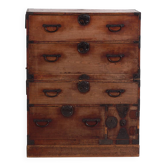
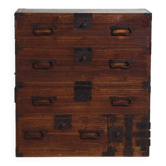
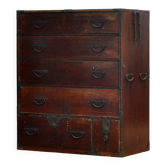
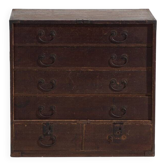
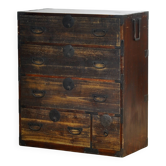
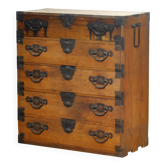
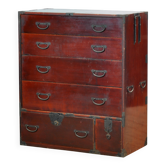
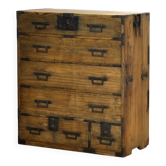
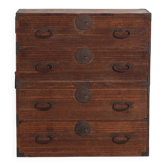
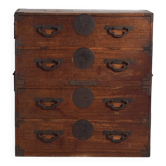
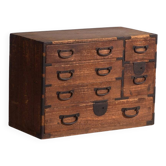
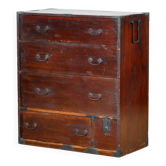
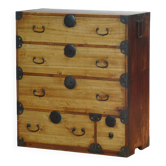
Japanese merchant chest (Choba-dansu) made of keyaki wood – Meiji–Taishō period (c. 1880–1920)

- Dimensions :
- H104 x W89 x D43
- Color :
- printed
- Material :
- wood
- Style :
- world's craft
Japanese merchant tansu (chōba-dansu) made of keyaki wood, dated between the end of the Meiji period and the beginning of the Taishō period, circa 1880–1920. This type of Japanese merchant tansu, known as chōba-dansu, was used in shops and merchants' homes to store documents, money, and commercial records. Its structure combines several drawers with a secure compartment designed to organise valuable items. The piece features five main drawers of varying sizes, as well as a side compartment with a door concealing small interior drawers, a typical characteristic of traditional Japanese furniture used in commercial environments. The exterior is primarily made of keyaki wood (Japanese zelkova), one of the most valued woods in antique Japanese furniture. Known for its strength and the beauty of its grain, keyaki was often used for visible parts, while the interior could be made of sugi (Japanese cedar) or kiri. The piece retains its original forged iron fittings, including handles, reinforcement plates, and a lock plate. These elements strengthen the structure while reflecting the aesthetic of furniture from the Meiji period. An interesting detail is the presence of a fragment of old printed paper affixed to the side panel, likely a calendar or advertisement from the Meiji era, attesting to the historical commercial use of the piece. Today, this item can be used as a chest of drawers, storage unit, or decorative element in contemporary interiors inspired by wabi-sabi aesthetics, Japandi style, or minimalist interiors. Details. Dimensions: Length: 89 cm Depth: 43 cm Height: 104 cm. Origin: Japan. Period: Late Meiji – early Taishō period. Date of manufacture: circa 1880–1920. Materials and techniques: keyaki wood, sugi or kiri for secondary parts, forged iron fittings.
5 ()