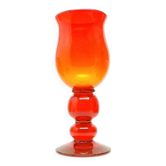
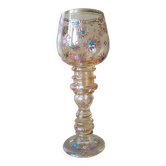
Mid-century modern vase, multicolour glass, designed by J. Słuczan-Orkusz, Poland, 1970s

- Dimensions :
- H24 x W11 x D11
- Color :
- multicolour
- Material :
- oak
- Style :
- mid-century
A vase designed by Jerzy Słuczan-Orkusz, created at the Krakow Glass Institute in the 1970s, representing Polish decorative glass in the spirit of modernism. It was made using the blown glass technique from transparent glass with a high degree of colour saturation. The palette of intense colours – from deep burgundy through warm red, orange, to amber-yellow at the base – creates a visible gradient that highlights the pure form of the vessel. The upper part takes on a rounded, bulbous shape, narrowing into a slender neck and a widely flared base. The surface is smooth and shiny, without external decorations – the accent is the colour transition and the sculptural silhouette. At the transition from the bowl to the base, traces of gluing and a seam line are visible, typical of artisanal production from that era. The product bears delicate scratches and other signs of use, classified as 'worn'. In this form, the voice of Polish 1970s resonates – bold colour and glass warmed by light evoke the atmosphere of aesthetic exploration that accompanied modernist interiors. The transparency of the material and the fiery gradient make this vase not only a utilitarian object but also a story of expression that transcended everyday boundaries. Every reflection on the shiny surface is a reminder of workshop precision and the spirit of creative experiments at the Krakow Glass Institute. This is an object that seems to catch rays of light like memories – fleeting but intense. The vase can serve as a solo accent on a walnut or oak sideboard, creating a colour contrast for light walls and textiles in natural shades. It will work well in modernist or eclectic arrangements, where it is worth pairing it with geometric ceramic forms, minimalist graphics, or a metal lamp from the era. Placed by a window, it will gain additional colour depth in natural light, and even a single branch will emphasise the harmonious line of this unusual form.
Vases: other similar vintage pieces
Discover more similar items- -15%
- -15%
- -15%
- -15%
- -15%
- -15%
- -15%
- -15%
- -15%
- -50%
- -61%