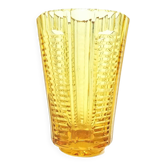
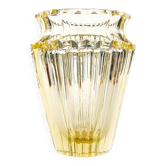
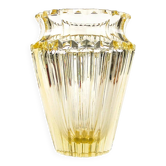
Diatret vase, mid-century modern, orange pressed glass, designed by J.S. Drost, Ząbkowice, Poland, 1970s

- Dimensions :
- H22 x W12 x D12
- Color :
- orange
- Material :
- glass and crystal
- Style :
- mid-century
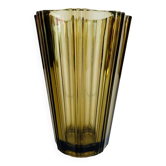
Diatret vase by Jan Sylwester Drost, designed for HSG Ząbkowice in Poland in the 1970s, made of pressed glass in an amber, vivid shade of medium saturation. The vase has a slender form tapering downwards, with distinct vertical grooves emphasizing the rhythm of the construction and referencing the mid-century modern canon present in Polish design of that decade. The central decorative element is a geometric band just below the rim, reliefed in a crown-like pattern—a clear, three-dimensional motif smoothly combining angles and soft bulges. The glass is smooth, polished, reflective, and effectively showcases the saturation of the colour. The precision of the bands and reliefs attests to the high level of craftsmanship of the Ząbkowice manufactory. The vase is in excellent condition—no chips, scratches, or cracks, with the entire glass structure clear and distinct. The spirit of those years pulses in this amber like light breaking through the greyness of the PRL era. Designed by Drost, the vase tells the story of an era when the pursuit of sculptural form and bold colours became a manifesto for Polish designers seeking modernity in everyday objects. The three-dimensional ornament, like a crown, whispers a story of design—of the combination of geometry and fluidity of forms, of light dancing on the shiny surface, and of the joy of experimenting with glass, which was the hallmark of HSG Ząbkowice in the 1970s. Each reflection and refraction of the glass recalls the unique energy of that time—as if the vase retained a shadow of the industrial odyssey of Polish modernism. This piece will work well as a striking accent against a monochromatic sideboard or on a shelf with other glass objects from the era. It can be paired with minimalist mid-century furniture, ceramics of simple forms, or light wood to highlight the depth of the amber glass. It works solo as a sculptural decoration, but also in a composition with other graphite or iridescent glass vessels, where the play of light and shadow will enhance its impressive silhouette. An interior with a collector's character will gain a strong, authentic accent of 1970s Polish design.
Vases: other similar vintage pieces
Discover more similar items- -15%
- -15%
- -15%
- -15%
- -11%
- -14%
- -15%
- -15%
- -15%
- -15%
- -15%
- -15%
- -15%