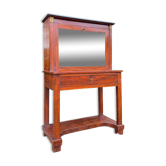
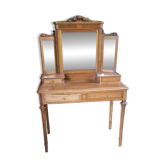
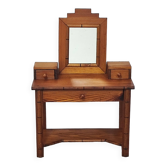
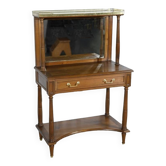
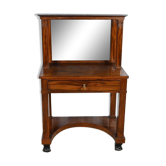
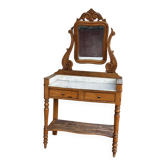
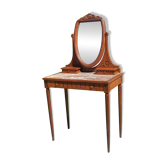
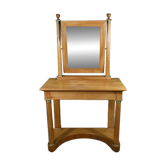
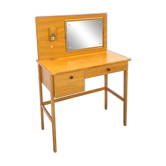
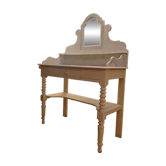
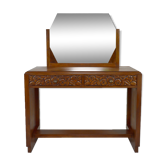
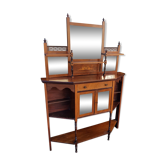
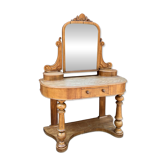
A newly discovered vanity table cabinet by Hugo Gorge c. 1920, Vienna

- Dimensions :
- H165 x W110 x D42
- Color :
- wooden
- Material :
- wood
- Style :
- art deco
This exceptionally well-preserved cherrywood vanity table, newly found by architect-designer Hugo Gorge, represents a rare and possibly unique example of early Viennese modernism. The piece, believed to date from around 1920, features a tripartite mirror, original glass worktop, and distinctive brass drawer pulls in the shape of a maritime propeller intersected by an anchor — a known Wiener Werkstätte motif listed under inventory number M/3103 in the MAK (Museum für angewandte Kunst, Vienna) archive. The vanity’s refined, rational proportions are softened by playful and architectural elements — a hallmark of Gorge’s design ethos. Beneath the central mirror, three compartments are separated by curved dividers carved from solid wood, combining functionalism with organic rhythm. The base cabinet is supported by slim square legs and stabilized by a stretcher bar, a structural motif Gorge frequently used. Notably, the brass fittings were produced by Paul Ritter’s Nachfolger, a documented collaborator of Gorge’s during the interwar period. While the MAK attributes the handle design to Hugo Gorge: the lightness, clarity, and whimsical narrative detailing clearly diverge from Hoffmann’s ornamental style and Gorge’s monolithic compositions. Remarkably, it retains all its original features, including the mirrors, brass hardware, and lacquer finish. The lighting fixture atop the mirror was likely added in the 1940s or 1950s and remains fully functional.