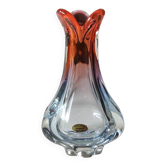
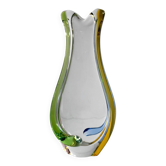
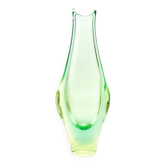
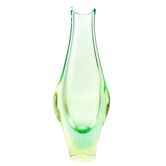
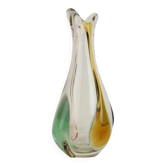
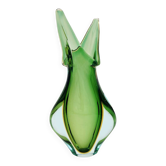
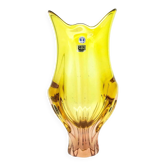
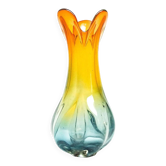
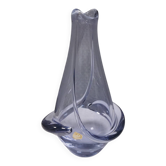
Mid-century modern vase, glass, designed by H. Mahanovska, Czechoslovakia, 1960s

- Dimensions :
- H17 x W9 x D9
- Color :
- multicolour
- Material :
- chrome
- Style :
- mid-century
A vase with an organic, teardrop-shaped silhouette from the Mstišov Glassworks in Czechoslovakia, designed in the 1960s by Hana Mahanovska, reflecting the mid-century modern aesthetic. Its thick, hand-formed glass features an eye-catching, flared and slightly wavy rim, adorned with transparent, irregular stripes in pastel shades—yellow-green, light blue, and subtle lilac—arranged asymmetrically around the body. The vase has a glossy, clear surface and visible, soft colour transitions, showcasing the craftsmanship of Czechoslovakian glassmakers of that era. The original manufacturer's label is preserved on the front, and the piece displays small air bubbles typical of hand production in the 1960s. It is in good vintage condition, with no visible major damage or repairs. The form of this vase is a calm manifesto of the 1960s, when colours and light co-created the aura of everyday objects. The pattern speaks of a fascination with nature and subtle geometry—the wavy rim and fluid pastel stripes evoke the shadowy surfaces of lakes and rays filtering through trees. Each colour break in the glass echoes an era that preferred breath, lightness, and organic rhythm over excessive ornamentation. The thickness of the glass gives a sense of solidity, while delicate bubbles trapped in the mass remind us of the human hands' work, captured in the crystal of a bygone time. Hana Mahanovska's vase can be a soloist on an oak chest of drawers or in the centre of a bright display case. It works well in mid-century modern arrangements but can also be combined with simple, geometric accessories in neutral colours or with other glass objects—especially white ceramics, raw wood, or chrome. In eclectic spaces, it will fit among books and textiles, highlighting the colourful layer of the composition with light passing through the pastel bands. It is worth displaying it where natural light will emphasise the iridescence and transparency of the glass, creating changing images on the furniture surface.
Vases: other similar vintage pieces
Discover more similar items- -15%
- -15%
- -15%
- -15%
- -13%
- -15%
- -15%
- -11%
- -17%