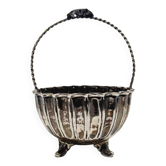
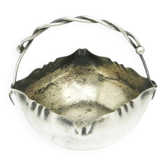
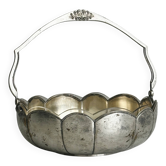
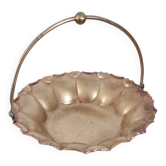
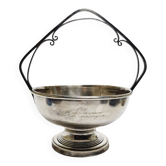
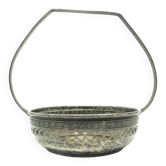
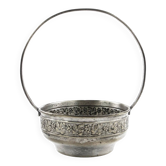
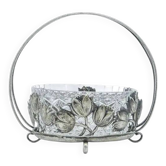
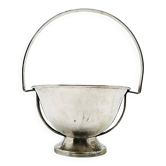
Art Nouveau sugar bowl, silver-plated brass, Henneberg Brothers, Poland, early 20th century

- Dimensions :
- H13 x W11 x D11
- Color :
- silver (Color)
- Material :
- brass
- Style :
- art nouveau
A sugar bowl from the early 20th century, made by the renowned Warsaw company Henneberg Brothers, represents Polish Art Nouveau in metalwork. Made of brass covered with a layer of silver, it features a cool, slightly matte finish and a discreet patina that highlights its age. The body refers to the form of a stylised flower – smoothly shaped petals form the walls of the vessel, and their subtle, organic texture reflects the nature-inspired motifs typical of Art Nouveau. The slender handle, arched and finished with a central ball, connects at two points with the low, wide bowl, which is supported by three small, spherical feet. The proportions are harmonious, and the whole reveals the high quality of craftsmanship and attention to detail characteristic of Henneberg Brothers' products. Condition is very good – slight darkening and minor surface abrasions are natural signs of age, with no visible dents or damage. The form of this sugar bowl tells the story of early modernism, when at the turn of the century Polish craftsmen drew from European artistic trends, giving everyday objects a new, organic fluidity. The stylised flower shape and soft lines of the handle evoke the spirit of Art Nouveau: an era when nature became a model, and metal – a material for decorative experiments. The delicate patina and tangible texture of the petals evoke the twilight of the belle époque – a time when even a simple table item aspired to be a small work of art. The sugar bowl can be paired with classic porcelain from the era or modern, minimalist accessories, highlighting the contrast between decorative form and simplicity. It will work well on an elegantly set table or in a collector's display case, where its sculptural silhouette will attract attention. It is worth combining it with elements from the Art Nouveau period – for example, a silver spoon with a wavy line or a decorative tray – or, conversely, exposing its organic detail in the company of bright, contemporary forms, building a subtle dialogue between old and new.
Sweet boxes & sugar bowls: other similar vintage pieces
Discover more similar items- -15%
- -15%
- -15%
- -19%
- -15%
- -15%
- -15%
- -15%
- -15%
- -15%
- -15%
- -15%
- -15%
- -15%
- -15%
- -15%
- -15%
- -15%
- -15%