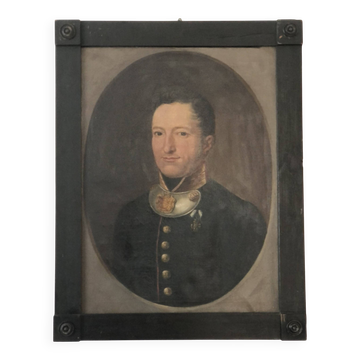
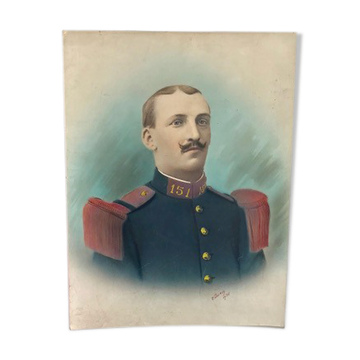
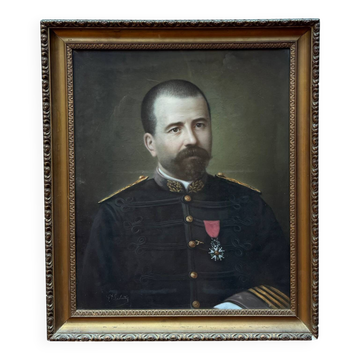
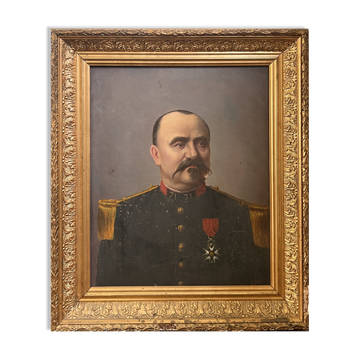
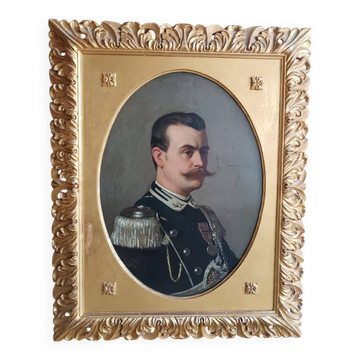
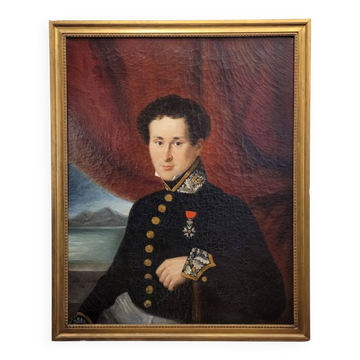
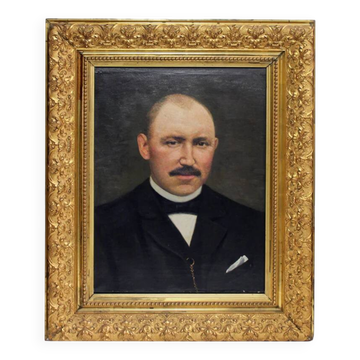
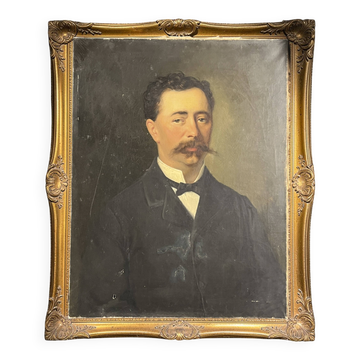
Portrait of a French army officer with a large mustache, around 1855–1870.

- Dimensions :
- H87 x W70 x D5
- Color :
- multicolour
- Material :
- canvas
- Style :
- vintage
Or the great-great-uncle that no one dared contradict. Every family tree has one. The relative who enters a room and the conversation reorganizes around him. If our wall of portraits is a salon of imaginary ancestors — and it is — then this magnificently mustached gentleman is the one who sits at the end of the table, with Opinions, a sword, and absolutely No intention of passing the salt until he has finished his story. He is an officer in the French army, painted with a sword at his hip and a mustache set like a clock. He is presented in a delightfully cartoonish style — with a somewhat theatrical gaze. And, we admit, this is exactly why we fell for him. He has personality — the kind that crosses a century and a half and still makes you smile from across the room. Look closely and his face is marked by fine cracks, that delicate map that time draws on old oils. On him, it reads less like age than like feeling — it softens all the martial assurance into something almost tender. He is formidable, yes. But he is also, in a way, entirely endearing. Reading the portrait. He wears his rank clearly: heavy golden epaulettes, an undeniable mark of an officer, and the famous garance trousers — those splendid red trousers that the French army kept until World War I. On his chest, two decorations. The first is immediately recognizable: the Legion of Honor, the highest French distinction, founded by Napoleon in 1802 and never awarded lightly — it had to be earned. The second is a radiant golden star on a dark ribbon: clearly the insignia of an order, although painted with enough popular artistic freedom that its exact name remains a mystery. This first medal also indicates his era. Under the empires, it bore a crown; the Republic replaced it with a laurel crown in 1870. His is crowned — he was therefore painted before this date, under the Second Empire of Napoleon III, making him the oldest in our family, around 1855–1870. The key-frame and the linen canvas hand-tacked to the back support this. A French tradition: the portrait in uniform. Being painted in uniform, at the turn of the century and before, was much more than vanity. For an officer, it was a legacy — an official record of rank, regiment, and hard-earned honors. It is unsigned, as these honest and characterful portraits often are — a close cousin in spirit to our Portrait of a French Military Man by Eugène Leygue, another officer who never learned to take himself too seriously. Its condition. It carries its age with grace. Overall, the portrait is in beautiful condition, stable — nothing that detracts from its considerable charm. Looking closer, one notes a few slight scratches on the surface of the canvas, and two very discreet diagonal marks at the bottom right that seem to be remnants of golden paint (?). Along the left edge, near the frame, there is a small loss of pictorial material — most likely due to the frame rubbing against the canvas over the years. A fine craquelure is present everywhere, particularly on the face, adding rather than detracting from its character. The canvas is still on its original key-frame, and the gilded wooden frame shows honest wear consistent with age. In short: a painting that has lived long, and is all the more beautiful for it. And a little idea, with a wink. He is wonderful in a child's room. We staged him on the mantel of a sky-blue room, presiding over a miniature biplane and a squadron of toy sailboats, looking absolutely delighted. Why raise a child with cheap posters that warp in a year, when you can offer them a real painting with one hundred fifty years of stories on its face. Surround them with beautiful things from the start. Isn’t that right. A French army officer · Legion of Honor · oil on canvas · France, Second Empire, circa 1855–1870.
Oil portraits: other similar vintage pieces
Discover more similar items- -52%
- -15%
- -32%
- -8%
- -20%
- -18%
- -40%
- -33%