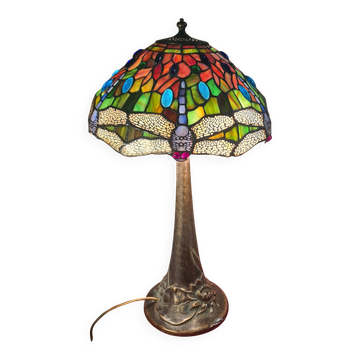
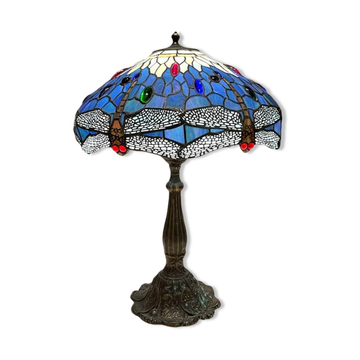
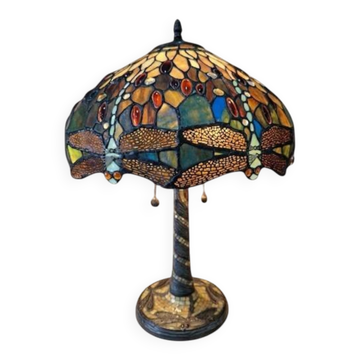
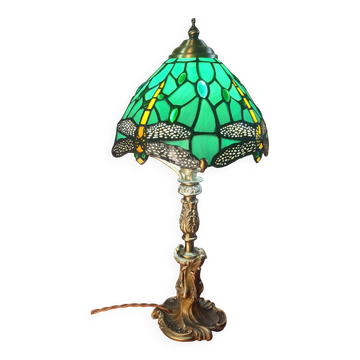
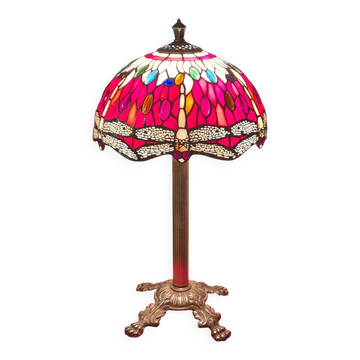
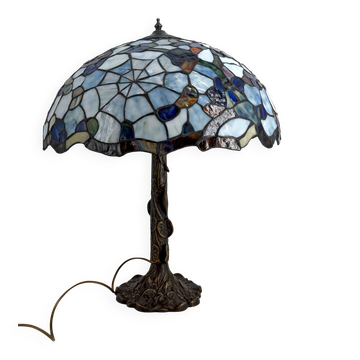
Art Nouveau Tiffany Style Table Lamp, Leaded Glass and Bronze, Dragonfly Motif

- Dimensions :
- H56 x W44 x D44
- Color :
- multicolour
- Material :
- bronze
- Style :
- art nouveau
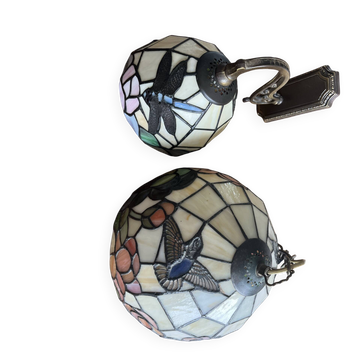
Art Nouveau Tiffany style lamp in leaded glass and patinated cast bronze. Inspired by the Dragonfly model that Tiffany Studios made famous around 1900, a domed leaded-glass shade encircled by dragonflies, raised on a cast base of twisting, bark-textured stem growing from a round foot modelled in relief with dragonflies at its base. Second half of the 20th century. This is a unique artistic take on Tiffany's Dragonfly lamp. Where most Dragonfly shades of this type are worked in strident multicolors, this one is built almost entirely from creamy opaline and oyster-white glass, softly mottled and faintly iridescent, with the dragonflies in amber, honey and tortoise shell tones. The bodies are set with a shell-like glass, an opalescent, mother-of-pearl quality, and the eyes are pairs of domed amber-coloured cabochons that catch the light like beads of resin. Also unique are the placement of the dragonflies on a diagonal. Their wingtips break through the lower edge, which is cut in a beautifully irregular rim. The base is cast metal with a warm bronzed surface and green verdigris in the recesses, the stem spiralling like a vine wrapped around a trunk, over a domed foot on ball feet. Twin E27 sockets (which take E26 US bulbs) on curved arms beneath a pierced ventilation cap with a turned finial. On the dragonfly. The insect was the signature creature of Art Nouveau, and not by accident. It arrived in European design through Japanese prints, where it stands for late summer and, historically, for victory. It suited the period's obsession with metamorphosis and impermanence — an animal that begins its life underwater and ends it in the air, and lives only briefly once it gets there. It was also, practically speaking, the perfect subject for glass: transparent wings, a jewelled body, an iridescent sheen. Lalique built his most famous brooch around one; Gallé and Daum returned to it repeatedly; and at Tiffany Studios the dragonfly shade, developed in the women's glass depar.
Bedside and table lamps: other similar vintage pieces
Discover more similar items- -34%
- -40%
- -11%
- -30%