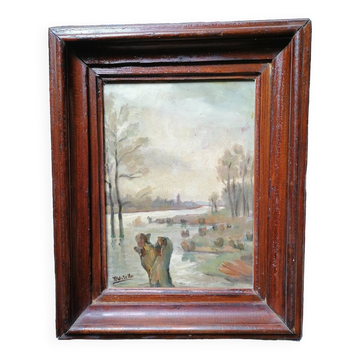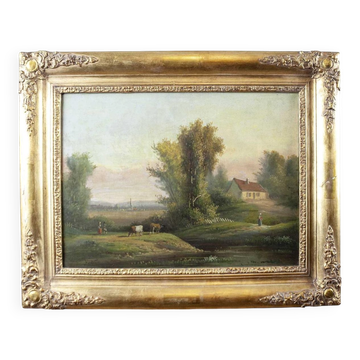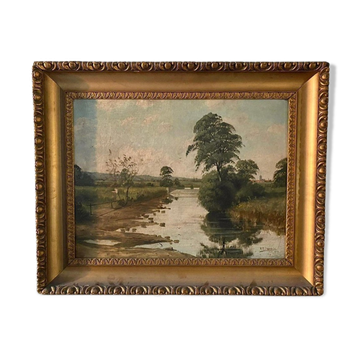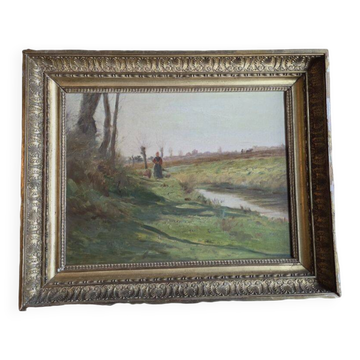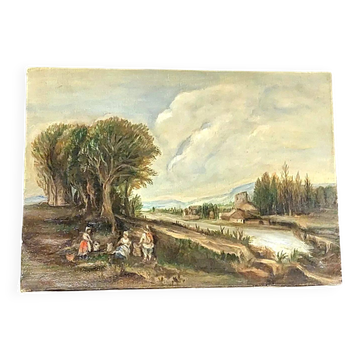

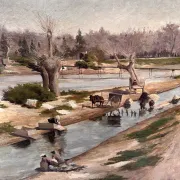
"Washers of the Manzanares", Madrid school, costumbrism, early 20th century – Spain

- Dimensions :
- H100 x W130 x D9
- Color :
- multicolour
- Material :
- canvas
- Style :
- classic
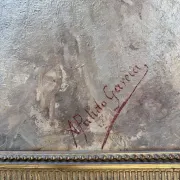
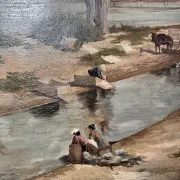
Exceptional oil on canvas belonging to the Madrid school of the early 20th century, this is a scene of costumbrismo depicting daily tasks. The painter shows the Manzanares River in the background, from which a canal flows where washerwomen and field workers with their carts and draft animals are found. The perspective of the work is composed of parallel diagonals that converge at a single point, formed by the river, the canal, the land between the two, and the path on the right of the work. These diagonals are interrupted by two horizontals, the bridge and the forest in the background, which give way to the sky. The dominant colours of the oil are earthy tones, such as brown, present in the trees and paths, and blue tones, present in the river, the canal, and the sky. The artist's signature is at the bottom right, A. Pulido García. The work belongs to the Madrid school of the 20th century, probably a disciple of the painter Aureliano de Beruete, a recognised landscape painter trained at the San Fernando Academy of Fine Arts. Thanks to his comfortable economic situation, he was able to dedicate his entire career to painting, particularly in the landscape or costumbrista genre; today, some of his works are found in the collections of the Prado Museum. He also became an important collector of artworks, owning a drawing by Michelangelo and a work by El Greco. His personal and professional situation allowed him to travel across Europe in the late 19th century, where he was influenced by Impressionist aesthetics and befriended Claude Monet and Joaquín Sorolla. His son, also named after him, would later become the director of the Prado Museum between 1918 and 1922. The costumbrista artistic movement refers to the customs, traditions, and practices of societies, representing the daily reality of what is depicted, both in the artistic and literary fields. This term became popular during the Romanticism of the 19th century, although earlier works in this genre can be found, such as those by Brueghel the Elder in the 16th century or Goya's paintings at the end of the 18th century. This movement became popular in the artistic field as a reaction to the dominant academicism, under the influence of French academicism, where the beauty of works was found not only in "high or superior" themes but also in the simple reality surrounding the painter. These are generally paintings with more amiable gestures and scenes, with a broad stroke, distant from Neoclassicism, tending towards later Impressionism. In Spain, costumbrista authors include Francisco de Goya in his early period, José Jimenez Aranda, or José Domínguez Bécquer, or Eugenio Lucas Velázquez in Madrid.
Antique paintings: other similar vintage pieces
Discover more similar items- -39%
- Sold out
- Sold out
- -28%