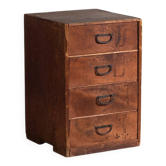
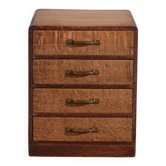
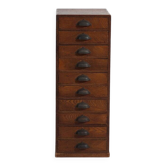
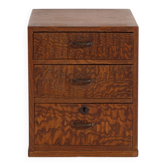
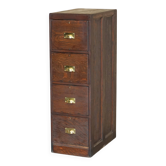
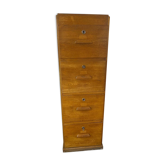
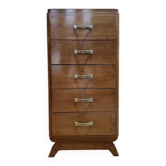
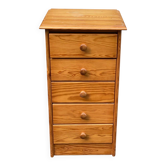
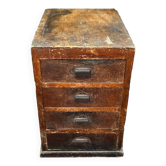
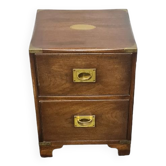
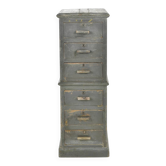
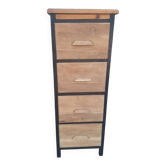
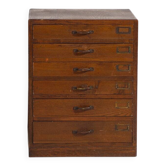
Japanese vertical ko-dansu with five drawers in paulownia and Japanese cedar, Taishō to early Shōwa period, circa 1912–1945.

- Dimensions :
- H43 x W23 x D38
- Color :
- brown
- Material :
- wood
- Style :
- vintage
Small vertical Japanese ko-dansu with five drawers made from paulownia wood (Paulownia spp.) and Japanese cedar (Cryptomeria japonica), originating from Japan and dated between the end of the Taishō period and the beginning of the Shōwa period, circa 1912–1945. This type of compact furniture was part of Japanese domestic furnishings used for storing documents, textiles, or personal items. The structure adopts a vertical format with five drawers of different proportions, each equipped with simple small metal handles. The design reflects the functional approach of early 20th-century Japanese furniture, where space optimisation and storage efficiency were essential. Paulownia wood was highly valued for its lightness, stability, and natural resistance to moisture, while Japanese cedar provides a solid and slightly aromatic internal structure. This combination of materials was common in domestic furniture intended for everyday use. The exterior surface today shows a deeply marked dark patina developed over time, with worn edges revealing the warm hue of the wood. This natural wear gives the piece an authentic and expressive character. Today, these small Japanese ko-dansu are highly sought after as desk organisers, storage furniture for small items, or decorative pieces in interiors inspired by wabi-sabi, Japandi style, or Japanese minimalism. Details. Dimensions: 23 cm width × 38 cm depth × 43 cm height. Style: Taishō Materials and techniques: paulownia wood (Paulownia spp.), Japanese cedar (Cryptomeria japonica) Place of origin: Japan. Era: Late Taishō – early Shōwa. Date of manufacture: circa 1912–1945. Condition: Good. Wear consistent with age and use with natural patina. This piece is part of the Amaru Antiques collection, Barcelona.
5 ()