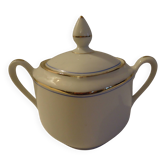
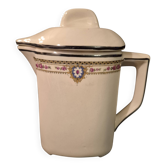
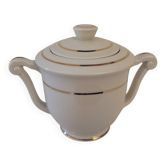
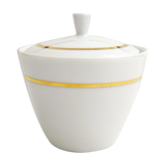
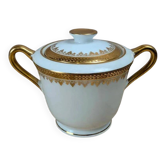
Mid-century modern sugar bowl, ivory ceramic, Ćmielów, Poland, 1960s

- Dimensions :
- H13 x W11 x D11
- Color :
- beige
- Material :
- linen
- Style :
- mid-century
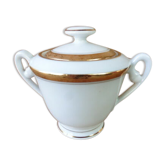
A ceramic sugar bowl from the 1960s, most likely produced by Ćmielów in Poland, features a classic mid-century modern form: a low, cylindrical body with a slightly convex lid and a simple, vertical handle. The ceramic in a warm, ivory shade is covered with an even, glossy glaze, giving the surface a subtle shine and smoothness. The ornamentation is limited to two narrow gold bands running around the upper edge of the body and lid, slightly worn in places. The gilding emphasizes the minimalist character of the design; the lack of additional decorations or painted motifs allows focus on the proportions and purity of the lines. Condition is very good – the ceramic is free of cracks and chips, with naturally worn gilding and a delicate patina, typical for vintage ceramics from this era. This sugar bowl clearly echoes the 1960s, when Polish design sought a balance between functionality and subtle decoration. The warm glaze shade evokes the atmosphere of old salons, where daily rituals took on a festive character. The gold bands on the rim, though partially faded, still discreetly reflect light, as if preserving echoes of past gestures and conversations at the table. This is an item that does not impose itself with form, but with elegance and restraint fits into the story of Polish modernism, where detail and quality of workmanship mattered. The sugar bowl will fit perfectly on a sideboard or console in the living room, where it can be a delicate accent against wood, marble, or fine glass. It can be combined with other period vessels – porcelain or glass – to create a collector's composition. Interiors arranged in the spirit of mid-century modern or those combining different decades and styles will gain coherence when the sugar bowl is paired with a simple mirror in a wooden frame or a lamp with a milky shade. It is worth using it both functionally and decoratively, emphasizing its timeless character.