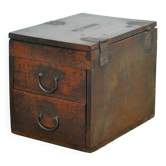
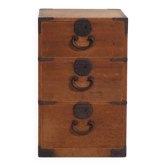
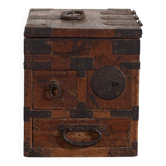
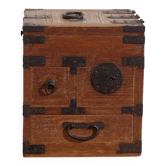
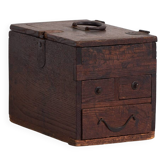
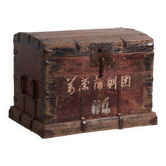
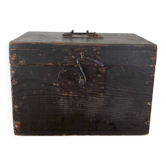
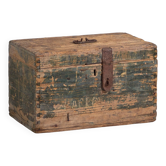
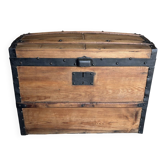
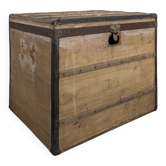
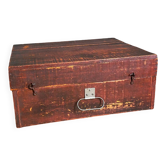
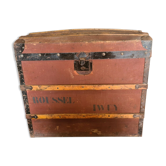
Japanese ko-dansu with hinged lid and paulownia wood drawers, Meiji–Taishō period, circa 1868–1926.

- Dimensions :
- H24 x W20 x D26
- Color :
- brown
- Material :
- wood
- Style :
- classic
Small Japanese ko-dansu with a hinged lid and front drawers made of paulownia wood (Paulownia spp.), originating from Japan and dated between the end of the Meiji period and the beginning of the Taishō period, circa 1868–1926. These small storage pieces were part of Japanese utilitarian furniture and were commonly used to store documents, seals, personal items, or small tools. The piece features a compact structure reinforced by wrought iron fittings and protective plates, typical of Japanese furniture intended for everyday use. The front includes two drawers with metal handles, while the top opens with a hinged lid equipped with a carrying handle, revealing a spacious interior compartment. Paulownia wood was particularly valued for this type of furniture due to its lightness, stability, and natural resistance to moisture and insects. The surface now exhibits a deep dark patina developed over time, with areas of wear revealing the natural grain of the wood and creating a striking contrast with the patinated iron fittings. Today, these small Japanese ko-dansu are often used as desk organisers, storage boxes, or decorative objects, fitting perfectly into interiors inspired by wabi-sabi, Japandi style, or Japanese minimalism. Details. Dimensions: 20 cm width × 26 cm depth × 24 cm height. Style: Meiji. Materials and techniques: paulownia wood (Paulownia spp.) Place of origin: Japan. Period: Late Meiji – early Taishō Date of manufacture: circa 1868–1926. Condition: Good. Wear consistent with age and use, with original patina. This piece is part of the Amaru Antiques collection, Barcelona.
5 ()