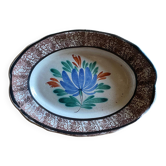
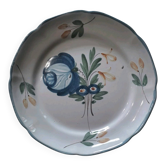
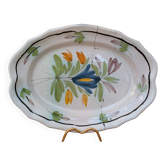
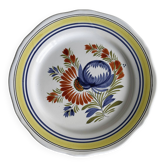
Very old Norman dish called "Cul-noir".

- Dimensions :
- H4 x W37 x D27
- Color :
- blue
- Material :
- ceramics, porcelain and earthenware
- Style :
- classic
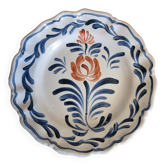
What I like about antique objects is their uniqueness. Firstly, they are the result of artisanal work, a transmitted know-how, a "signature, " and that is quite precious in a world of moulds and standards. And especially because these objects have flaws, atypical touches. The dish I am presenting here... You can feel its uniqueness just by holding it in your hands, as it has a very particular curved shape, almost containing. Of course, this is my subjective experience, but if you also appreciate those little extra details, I am sure you will enjoy this ceramic piece. Look at the photos and you will notice this inclination! Technically, it is a dish that seems to have been made in the mid to late 19th century and has been stapled. It belongs to the tradition of "Cul noir" ceramics. Traditionally, the so-called "cul noir" faience dishes are characterised by a reverse covered with a dark brown to black glaze, usually obtained with a manganese glaze. The visible face is covered with a white glaze and decorated with patterns, most often floral or inspired by Rouen decorations. This production is characteristic of the faience factories of Rouen, the Pays de Caux, Tours, and Malicorne-sur-Sarthe, where this know-how developed from the 18th century onwards. This dish is observed vertically, with a central floral motif in blue, orange, and green tones, with a wavy blue border around the edge. It is also quite fine compared to dishes of this type.
Dishes: other similar vintage pieces
Discover more similar items- -13%
- -6%
- -7%
- -13%
- -55%
- -29%
- -21%