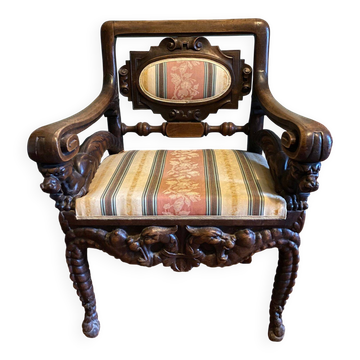
Anglo-Indian armchair, padauk wood, Victorian era, circa 1880 – Burma / Republic of the Union of Myanmar

Wonderful Anglo-Indian armchair, with a spectacular design typical of furniture and craftsmanship made during the period of British colonialism in the region of India. The armchair features a large backrest, carved and decorated with vegetal motifs such as leaves and flowers, a decoration that continues on the armrests, the base, the frieze below the seat, and the legs, finished with scrolls (probably a British heritage). Traditionally, this decoration was believed to symbolize prosperity and well-being for the buyer. The piece is made of padauk wood; padauk wood, or redwood, is native to central and tropical West Africa, from Nigeria east to Congo-Kinshasa and south to Angola. It is obtained from a large type of Pterocarpus species. Usually called narra or mukwa, padauk wood is a valuable resource due to its robustness, resistance, and stability once worked. Its reddish color is quite distinctive, although it can be confused with rosewood. Its heartwood is a pale orange or deep reddish-brown, but its color darkens once the wood is cut and exposed to light. With a generally straight grain, African padauk's texture is open and coarse, with a fine natural sheen. It is immune to termites and other insects and is very easy to work, which allows for this type of carving, even with profuse openwork. Anglo-Indian furniture is one of the most curious and special in art, as it combines the techniques and skills of Indian craftsmen with more 'classic' and British furniture profiles, resulting in a mix between the exotic and the traditional. This type of furniture was made in the region of India between the late 18th and 19th centuries. The piece features a reupholstered seat with a paisley print by the Italian firm Etro in reddish tones, a pattern that also connects with the Indian influence of the armchair as it is inspired by an Indian pine design, called 'buto' or 'boteh', originating from the 11th century and representing life and fertility.
Lounge & easy chairs: other similar vintage pieces
Discover more similar items- -5%
- -15%
- Sold out
- -32%
- -21%
- -5%
- -10%
- -20%
- -8%
- -58%