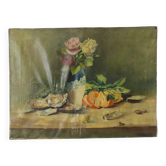
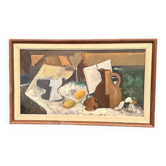
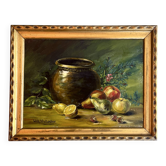
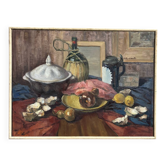
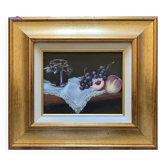
HSP painting Still life with oysters and lemon signed (to be deciphered) early X
This item has found its owner, but other one-of-a-kind items await you. 👇
Discover similar items- Dimensions :
- H35 x W65 x D10
- Color :
- multicolour
- Material :
- wood
- Style :
- classic
Painting made in oil on wood panel dating from the beginning of the last century. Signed (to be deciphered). A lot of charm for this work whose support will deserve some attention - see photos, contractual. Panoramic dimension: 23 / 60 cm. For any additional information or to send photos for enlargement, do not hesitate to contact me directly: sylvere.carlier@neuf.fr Midy Ernest Ernest Midy was a Belgian artist, born in Brussels in 1877 and died in Kalmthout in 1938. He was a painter and watercolorist. He trained at the Academy and the Higher Institute of Antwerp, under the direction of F. Van Leemputten. In 1898, he participated in the preparatory competition for the Prix de Rome and in 1901 registered for the entrance exam for this Prize. He became director of the Municipal School of Drawing in Mol (1903-1914). During the First World War, he was imprisoned as a prisoner of war in Soltau. There, he became deaf. He lived in Mol and had his studio in Mol-Sluis, where he received his friends Edgard Farasyn and Floris De Cuyper. He found inspiration in the Campine landscape and the simple people who lived there. Among other things, he created portraits, figures, and melancholic landscapes of the Campine, firmly fixed in paint paste. Excerpt from the press: "Painting nature and its daily miracle of light: this becomes for him an act full of consecration, an act full of mysticism. It becomes ecstasy or prayer" and "It should not be surprising that the names of Millet, with his consecrated romanticism, and of the master Th. Verstraete, who also succeeded in enveloping Campine life in so much mystery and modesty of light that his art becomes almost a religious art." (J. Crick) After the First World War, the Drawing School was not reopened until 1930. Ernest Midy spent the rest of his life in Kalmthout, somewhat withered. He is mentioned in CRICK, BAS II and Two Centuries of Artists' Signatures.
4.95 ()
Antique paintings: other similar vintage pieces
Discover more similar items- -25%
- -40%
- -20%
- -20%
- -35%
- -40%