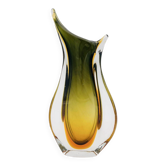
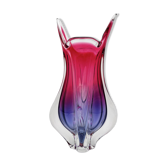
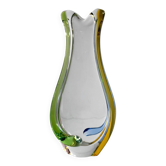
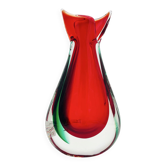
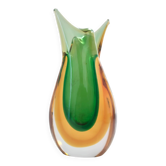
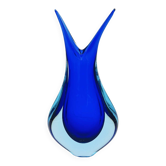
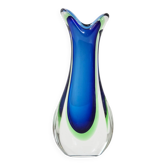
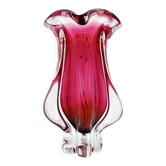
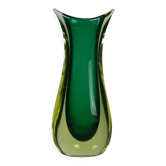
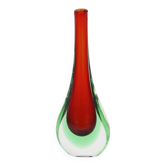
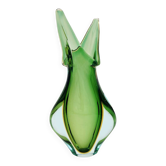
Mid-century modern vase, multicolour glass, designed by H. Mahanovska, Czechoslovakia, 1960s

- Dimensions :
- H20 x W10 x D10
- Color :
- multicolour
- Material :
- jute
- Style :
- mid-century
A vase designed by Hana Mahanovska for the Mstišov Glassworks in Czechoslovakia, created in the 1960s as an expression of mid-century modern trends in glass art. Hand-formed, it features an organic drop shape topped with a delicately flared, asymmetrical rim. On one side, light passes through a cool, transparent blue, while on the other, a juicy green glow emerges—both shades surround the central core of amber-orange glass. The colour composition creates a distinct gradient and emphasises the layered structure of the glass. The surface is finished to the highest gloss: smooth, undiffused, and intensely reflective. There are no decorative patterns or matting—only fluid lines of colour following the natural movement of the glass. The mass of the vessel, solid base, and clear weight, characteristic of artistic glass from this era, complete the whole. The vase is in good and original condition, with no chips or repairs, only a few minor scratches inside. This vase could tell the story of the 1960s as a time of bold colour exploration and free, biomorphic forms. Like a dialogue recorded in glass between the fresh modernism and the fascination with the properties of light, the object seems to capture a moment of pulsating colour—as if time flows more slowly here, allowing for admiration of the material and subtle expression. The shiny surface acts as a mirror of the era: it shows the designer's broad gesture and strives for clarity without unnecessary embellishments. The vase can be displayed as an autonomous sculpture on a wooden console in the living room—its intense colours contrast well with a neutral background, especially against light or raw walls. It can be paired with transparent ceramics, a single geometric graphic, or minimalist vintage mid-century furniture—such contrast will highlight its organic line and multi-layered glass gradient. In an eclectic arrangement, it works well among other glass objects from the 1960s or in dialogue with ceramic sculptures, emphasising the interplay of materials and forms.