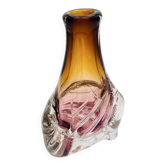
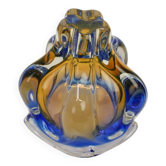
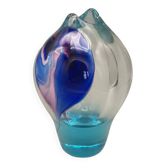
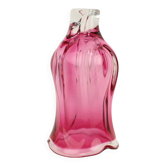
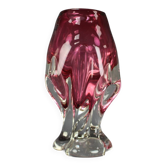
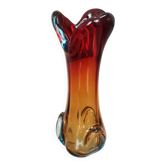
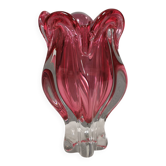
Donkey vase, red glass, designed by C. Zuber, Poland, 1970s

- Dimensions :
- H20 x W10 x D10
- Color :
- red
- Material :
- linen
- Style :
- mid-century
The 'Donkey' vase, designed in the 1970s by Czesław Zuber for Huta Sudety, represents the highest artistry of Polish modernist glass. Made from thick, hand-blown glass, it features a fluid, organic silhouette: the central body in an intense, saturated shade of red transitions at the top into striking protrusions, stylised as petals, broken by a milky white, semi-transparent layer at the edges. The shiny, polished surface brings out the richness of colours, while the cylindrical base subtly stabilises the whole, accentuating the sculptural, somewhat expressive composition. The body has no visible joints or seams, proving the vase was formed as a single, deliberately conceived object. Preserved in very good condition—no chips, cracks, or signs of restoration—this is a collectible example of Polish mid-century modern. The vase tells the story of a decade of exploration in Polish design: the 1970s were a time of bold colours and experiments with form, reflected in the interplay of light on its red and white. The glass, shaped in organic lines, evokes the untamed energy of the modernist era, when craftsmen and designers built a new vision of everyday life—functional, expressive, and close to art. The convex petals resemble a donkey's squinting eye or a sweeping painterly gesture, introducing movement and lightness, making the vase not just a vessel but an autonomous sculpture. It works best as a striking soloist on a console or light wood shelf—pair it with minimalist furniture of simple forms or mid-century modern decorations, such as geometric ceramics or textiles in pure colours. Eclectic interiors will gain an optical focal point that enlivens a neutral palette. Pay attention to material contrasts—glass pairs well with mattes: concrete, raw marble, or natural linen. The vase can be displayed empty or with single graphic branches to enhance its sculptural character.