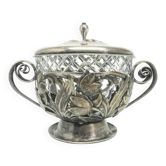
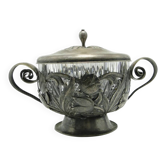
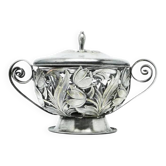
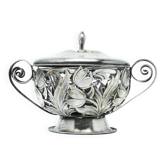
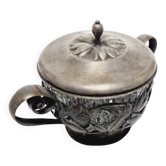
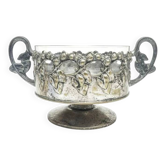
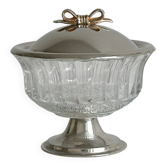
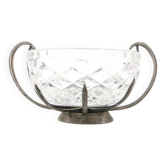
Art Nouveau sugar bowl, silver-plated brass, Poland, 1920s

- Dimensions :
- H15 x W14 x D18
- Color :
- silver (Color)
- Material :
- linen
- Style :
- art nouveau
A sugar bowl from the 1920s is an example of Polish artistic craftsmanship characteristic of the Art Nouveau period. Made of brass covered with a layer of silver, it features a matte-semi-gloss finish with a cool silver tone, locally darkened by natural patina, especially visible on the base and floral details. The interior is complemented by a cut glass insert with a diamond pattern, which reflects light and introduces a subtle shine. The whole is decorated with three-dimensional, organic floral and leaf motifs typical of the Art Nouveau style: flowing lines, naturalistic shapes, and symmetrically curled handles. The lid is convex, with a round, comfortable handle matching the silver-plated finish. Visible joints and soldering are made with attention to detail, in accordance with the craftsmanship standards of the early 20th century. Condition is good – there are signs of aging, patina, and minor surface abrasions, without serious damage or repairs. This item speaks with the voice of an era when nature and craftsmanship met in the fluid ornaments of Art Nouveau. The silver-plated body and glass insert evoke the atmosphere of elegant interwar salons, where the daily ritual of serving tea became a small celebration. Delicate darkening and subtle traces of time give the sugar bowl authenticity, as if telling of past gatherings at the table and moments frozen in the glow of milky light. The sugar bowl can be paired with period-style porcelain or cut glass, creating a complete table arrangement in the spirit of Art Nouveau. It will work well both on a classic linen tablecloth and alongside minimalist, modern accessories, where its decorative character will become a distinctive accent. It will bring charm to collector's interiors, eclectic dining rooms, or as a detail on a console in the living room, emphasizing the connection between history and everyday life.
Sweet boxes & sugar bowls: other similar vintage pieces
Discover more similar items- -17%
- -20%
- -45%
- -16%