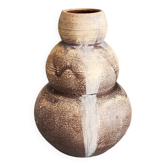
Roger Guerin, monumental trilobed vase, unique piece, 102 cm tall, salt-glazed stoneware

- Dimensions :
- H102 x W50 x D50
- Color :
- multicolour
- Material :
- ceramics, porcelain and earthenware
- Style :
- art nouveau
ROGER GUERIN (unique piece), museum-quality and monumental vase, 102 cm tall, circa 1920. Stoneware with a "high-fire salt glaze," in a gourd shape, trilobe type. Signed on the side, within the underglaze (see photo), the vase has a hole in the base. Biography: Roger Guérin (1896-1954) was a renowned Belgian ceramist (Bouffioulx) of the 20th century, particularly of the Art Deco period. He was a friend of Edgard Aubry. Born in Belgium in 1896, he showed a keen interest in ceramics from a very young age. He enrolled at the Charleroi vocational school where he took pottery classes with Willem Delsaux. Moving from the Art Nouveau period to Art Deco (between 1915 and 1945), he created vases and sculptures in "high-fired stoneware" using a single firing (1300°C). He thus skillfully navigated both artistic styles of his time. From 1934 to 1939, he was appointed Professor at the Higher School of Decorative Arts of La Cambre in Brussels. Perfect in his work, he was contacted for numerous artistic collaborations and produced pieces for renowned artists (Belgian and international) such as Marcel Wolfers, Cris Agterberg (Amsterdam School, Netherlands), Thierry Van Rijswijck, Domien Ingels, Cris Lebeau (Amsterdam School, Netherlands), Angelo Hecq, and others. Vases with wrought-iron mounts were the result of a collaboration with François Carion, creator of lighting fixtures and lamp bases for the French crystal manufacturer Muller Frères Lunéville. He participated in numerous exhibitions and notably won the silver medal at the 1925 International Exhibition of Modern Decorative and Industrial Arts in Paris. His international recognition led to his work being exhibited at the Jensen Gallery in New York in 1947. His preferred forms are: the spherical, faceted, and geometric vase (quite timeless), and sculpture. His work is comparable to the works of Auguste Delaherche, Pierre Adrien Dalpayrat, Emile Lenoble, Léon Pointu, and Ernest Chapl.
Vases: other similar vintage pieces
Discover more similar items- -17%
- Sold out
- -25%
- -12%
- -62%
- Sold out
- -25%
- -13%