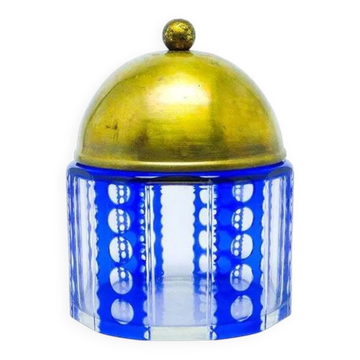
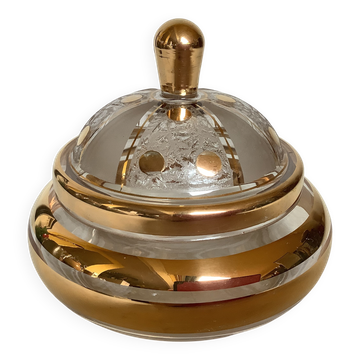
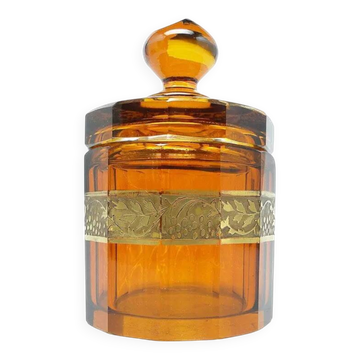
Art Deco bonbonniere, double-layered glass, brass, Germany, 1930s

Art Deco bonbonniere from the 1930s, originating from Germany, featuring clear characteristics of early applied art from this period. Designed from double-layered glass—transparent and intensely cobalt blue—it attracts attention with its cylindrical, faceted body decorated with vertical stripes and rhythmic rows of circles and dots. The shiny glass surface highlights the depth of colours, while the lid made of matte-satin brass, in the form of a high dome topped with a spherical handle, contrasts the metal with a light patina and the glass with its clear texture. The construction is based on a precise combination of glass and metal, ensuring durability and a clear silhouette typical of the Art Deco style. The bonbonniere remains in good vintage condition: the glass is preserved without damage, and the brass lid shows subtle signs of use consistent with the age of the item. This bonbonniere echoes the voice of modernising Europe of the 1930s: the lightness of glass meets the luxury of metal, and the geometric ornamentation evokes the spirit of an era where decorativeness gained expressiveness through symmetry and clarity of form. The faceted cobalt glass shines with light in a way that seems to tell of luminous evenings in Berlin salons—where small, everyday objects were meant to emphasise rituals of elegance. The patina of the brass is a silent witness to past decades and places the item in the history of pre-war modernism. The bonbonniere can successfully become the central point of a sideboard or table in a living room maintained in the Art Deco or modernist style—especially surrounded by chrome lamps, mirrors with clean lines, or lacquered woods. It will also look great in eclectic collector's interiors, where, combined with crystals, black glass, or dark marble, it will emphasise its geometric, collectible character. It can be combined with other items from the era or contrasted with minimalist accents to highlight the monumentality of the colour and details of the glass. No specific dimensions or care instructions are provided—it is recommended to clean the glass gently with a soft cloth and avoid corrosive agents on the brass surface. The construction remains stable, and the spectacular combination of glass and metal ensures the durability typical of German craftsmanship from the interwar period.
Sweet boxes & sugar bowls: other similar vintage pieces
Discover more similar items- -11%
- -24%