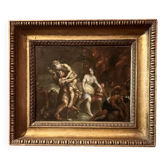
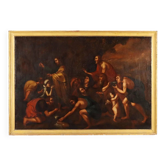
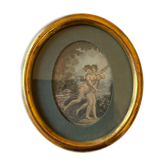
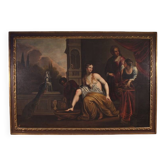
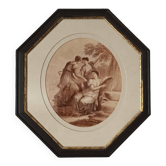
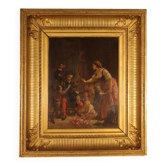
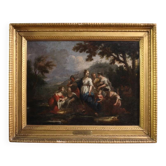
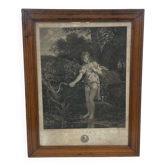
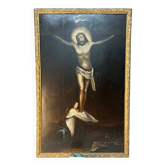
Pair of old paintings on slate, religious subject, 17th century.

- Dimensions :
- H37 x W26 x D3
- Color :
- black
- Material :
- linen
- Style :
- classic
Oil on slate. Two examples of oil painting on stone are presented here, a particularly popular genre in the Republic of Venice between the 16th and 17th centuries, in the form of oil painting on slate or touchstone. The choice of such a dark stone as a background is not only related to practical reasons (the proximity of the mines in Brescia and Val Brembana), but, as our two works clearly demonstrate, the emergence of figures from the dark background also responds to the new demands of painting at the time, which, in the climate of the Counter-Reformation, tended to express not only the idealised existential certainties of the High Renaissance but also the anxieties and openness to new phases, already with Tintoretto moving towards greater attention to reality and luministic contrasts, ultimately converging overwhelmingly into the research of the 17th century, which was heavily focused on the contrasting association of light and shadow. The two works presented here, fully embedded in the production of the Venetian area in the early decades of the 17th century, depict two figures of saints, both hermits, set against a barely visible dark naturalistic background. The figure of Mary Magdalene emerges from the darkness, bending to follow the curve of the stone support; she is depicted looking questioningly into the darkness, as if in a listening attitude, her left hand raised and the other resting on the remarkably shortened "memento mori." In front of her, a whip and a pot of ointment. Painted as a pendant, Saint John the Baptist is represented as a young man, with a lamb at his feet, holding in his hand the processional cross with the banner "ecce agnus dei, " while with his right hand he draws from the water source, recalling the episode in which Jesus Christ is baptised. In both paintings, the figures stand out strongly and incisively thanks to the black that characterises the slate on which they are depicted. The two paintings, in oval format, are presented in black wooden frames from the late 19th century.
4.94 ()