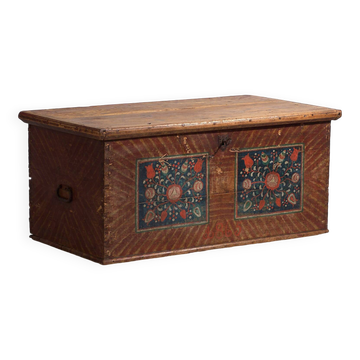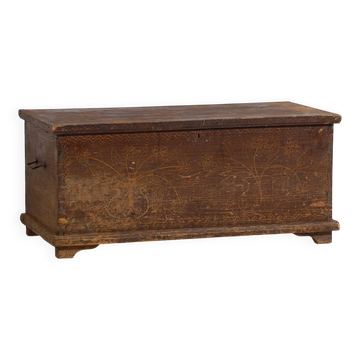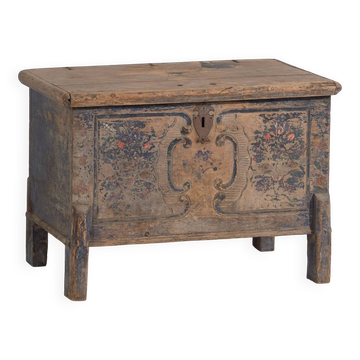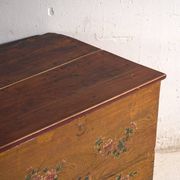
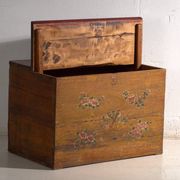
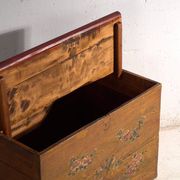
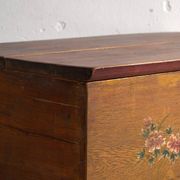
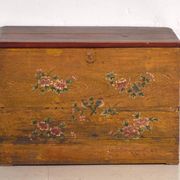
Antique Chinese chest with painted flowers in elm – China, circa 1900
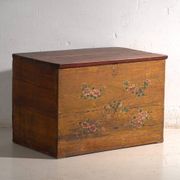
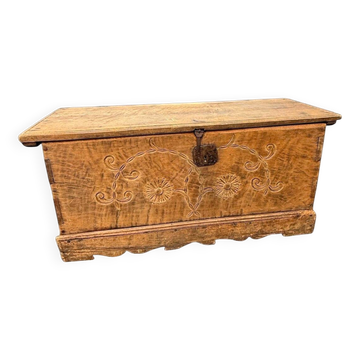
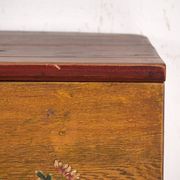
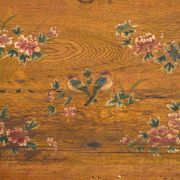
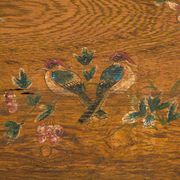
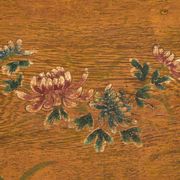
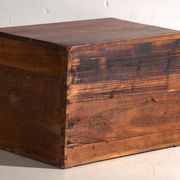
This ancient Chinese chest with painted flowers in elm is a dowry chest with a sliding lid and free floral decoration. It originates from northern China, from the Qing dynasty, where the elm was joined with dovetails and lacquered in ochre before being painted. Unlike closed composition chests, this one has no frame or border: the flowers are freely distributed across the front, as if they had simply landed there. This is a technique from northern folk painting, quicker to execute and more in line with domestic taste than commissioned work. The case is made of solid elm, with visible dovetail joints at the corners. The lid, made of two boards, slides on the upper edge and features a front crosspiece lacquered in red, the only accent of colour at the top. The sides and back remain undecorated. On the ochre background, five bouquets are painted: pink and garnet peony (mudan 牡丹), fine-petalled chrysanthemum (ju 菊) with small blue flowers among green leaves. The chrysanthemum is one of the Four Gentlemen and evokes contemplative retreat and longevity. The brushwork is quick, with dark outlines and light filling. The ochre lacquer has taken on a warm glaze and allows the grain of the elm to show through. The paint has lost some of its body, especially in the lower half, where contact with the ground has worn away the colour. The red edge of the lid retains its intensity better. Compact and at seat height, it serves as a side table, entry bench, or bedroom storage. It complements rustic, Japandi, and contemporary interiors with a warm palette. Details. Dimensions: Length 79 cm – Depth 53 cm – Height 55 cm. Style: Painted Chinese. Materials and techniques: Elm wood; dovetail joinery; ochre lacquer and hand-painted decoration. Place of origin: China. Period: Qing dynasty. Date of manufacture: Circa 1900. Condition / Observations: Good. Original lacquer and paint, pronounced wear on the lower half of the front. Wear consistent with age and use.
5 ()
Storage trunks & crates: other similar vintage pieces
Discover more similar items- Sold out
- -55%
- Sold out