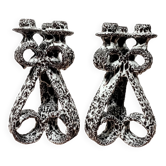
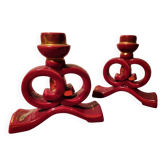
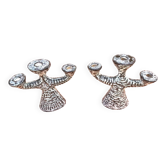
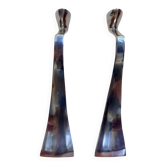
Pair of Large Three-Flame Candlesticks, Marius Giuge, Vallauris, 1960s

- Dimensions :
- H37 x W21 x D21
- Color :
- white
- Material :
- ceramics, porcelain and earthenware
- Style :
- vintage
A large pair of three-light candelabra, 37 cm high, featuring scrollwork at the top and base of the stem, constructed directly as a base with a "foam" pattern. The white color of these models is dotted with black cells that contrast with the light glaze. The technique used to achieve this effect involved adding chemical components to the glaze: depending on the chosen dosage, this created variations in the size and depth of the craters. This pattern, invented by Marius Giuge, inspired the "Fat Lava" ceramics, very popular in Germany in the late 1960s and 1970s. This pair of candelabra is an iconic example of Marius Giuge's work from the 1960s and 1970s. Each candelabra is signed underneath: MARIUS GIUGE – VALLAURIS stamp on each base. Marius Giuge, a key figure in Vallauris pottery (1909-1980), lived through the post-war boom years with his classical forms and glazes that bordered on kitsch. He inherited the pottery skills of his father, Philippe, who had settled in Vallauris and from whom he learned the craft. In 1947, he opened his own workshop. He initially worked on traditional pieces before turning to decorative ceramics. An excellent potter, his workshops flourished. In the late 1960s, he developed his famous "meerschaum" decoration, created by adding chemical components to the glaze to achieve variations in the size and depth of the craters. This decoration, applied to large pieces with shapes inspired by Greek antiquity, is emblematic of his work. It would later be adopted in West Germany by the industrialized factories of the post-war period, which in turn developed "Fat Lava." In 1975, Marius Giuge passed his workshop on to his daughter, also a ceramicist, thus perpetuating the history of a family tradition. Facing the consequences of the oil crises, the workshop closed permanently in 1980.
Candlesticks & candelabras: other similar vintage pieces
Discover more similar items