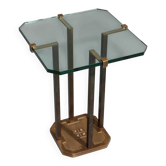
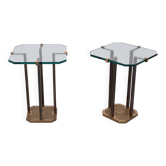
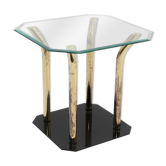
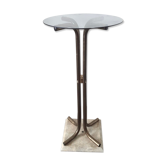
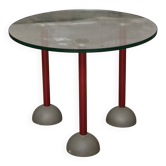
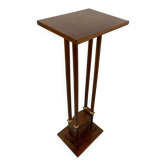
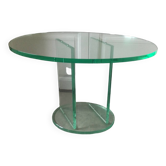
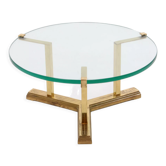
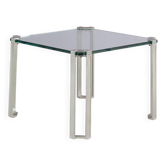
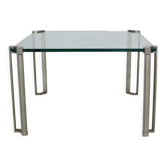
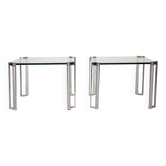
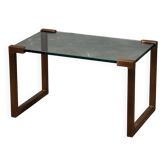
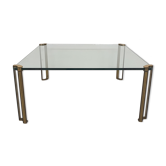
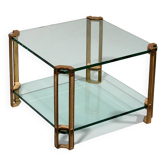
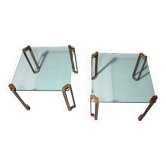
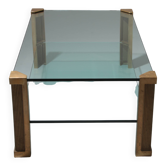
Peter Ghyczy t18 bronze cut glass sidetable, brutalist classic
This item has found its owner, but other one-of-a-kind items await you. 👇
Discover similar items- Designer :
- Peter Ghyczy
- Dimensions :
- H51 x W51 x D51
- Color :
- golden
- Material :
- bronze
- Style :
- brutalist
Beautiful brutalist classic sidetable designed by Peter Ghyczy in the 1970s. The sand cast base, in solid brass, features the Ghyczy logo. Typical for the sand-casting process, small irregularities may exist, even in the polished surface. The 15 mm glass plate is 51 X 51 X 50, 5 cm. German designer Peter Ghyczy was born in Budapest, Hungary in 1940. Following political unrest, Ghyczy’s family fled Budapest in 1956, moving first to Vienna, then to Bonn in Germany. Ghyczy finished his secondary education in Germany, studying sculpture in Düsseldorf before studying architecture at the Technical University of Aachen in 1960, specializing in constructional engineering. He graduated in 1967, having written his thesis on unconventional school buildings. During his studies, Ghyczy worked as an assistant to renowned German architect Rudolf Steinbach (1903-1966), and on projects in Paris and Egypt. In 1969, he became a German citizen. After graduating, Ghyczy worked on a large number of designs produced by furniture makers and factories in Germany, including Vitra. Ghyczy’s most successful design in this period was the Garden Egg Chair (1968) for Reuter, which remains one of his most recognizable designs today and is one of the earliest known examples of a hinged chair. The Garden Egg Chair is often referred to in German-speaking design circles as the Senftenberger Ei, named after the East German city in which the chair was produced, after the technology to make the polyurethane was sold by Reuter to VEB Synthesewerk. Due to the new location of Ghyczy’s Egg production, the chair became an icon of East German design in the 1990s. Working only with plastic as a material, Reuter also produced Ghyczy’s Easy Chair (1971), and GN2 Lounge Chair (1971).
4.92 ()