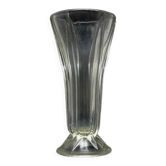
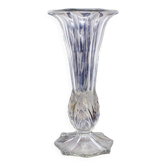
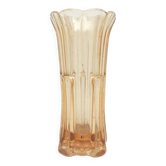
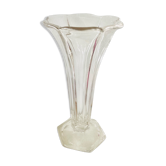
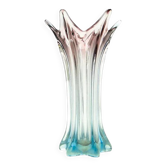
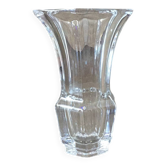
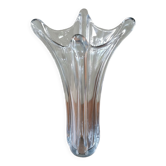
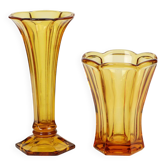
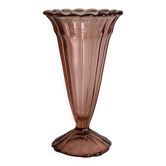
Art Deco vase, glass, Poland, 1950s

- Dimensions :
- H22 x W12 x D12
- Color :
- transparent
- Material :
- glass and crystal
- Style :
- art deco
A vase from the 1950s, made at the Krosno Glassworks, represents the Art Deco style in decorative glass of post-war Polish production. This model stands out with its transparent glass structure in a cool tone, with the lower part broken by a subtle, warm, yellowish hue. The vase's form is built by distinct vertical facets running from the massive base to the wide, flared, goblet-like mouth, typical of Art Deco's geometric inspirations. The entire piece is carefully polished; light reflects sharply on the glass reliefs, highlighting the precision of handcraftsmanship. The thickness of the glass ensures stability and durability, and the proportions—a narrowing stem gently transitioning into a flared top—demonstrate a design intent focused on harmony and functionality. The condition is described as very good—no visible chips, cracks, or significant signs of age. This vase seems to tell the story of Polish modernism: the cool simplicity of the glass form combines with a subtle play of light, evoking the post-war era's pursuit of renewal and everyday elegance. The geometric rhythm of the faceted grooves echoes the architectural divisions of those years, while the broken light emphasizes an atmosphere of clarity—a style aspiration that needs no ornament. The unhurried precision of the cut was paired with the desire for each vessel to offer more than just utility, becoming part of a new daily ritual. The vase can be used in a modern living room—it will fit perfectly against neutral greys, beiges, or strong mid-century modern tones. It can be placed on a low console, next to ceramics of simple shapes or minimalist frames with geometric graphics. It brings a subtle, collectible accent to both vintage interiors and those drawing from eclecticism. It also works well with a single branch or a flower with a distinct contour, emphasizing the dialogue between light and glass, serving as a balanced focal point in a domestic composition.