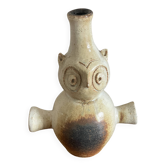
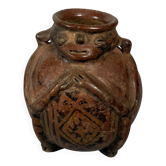
Jacques POUCHAIN, zoomorphic vase

- Dimensions :
- H17 x W22 x D12
- Color :
- brown
- Material :
- ceramics, porcelain and earthenware
- Style :
- world's craft
Zoomorphic vase in chamotte stoneware with incised and modeled decoration, slip and partial glaze. Signed under the base: "JP Dieulefit". Dieulefit, circa 1960–1970. Zoomorphic vase in chamotte stoneware with a globular body resting on a base rhythmically composed of short modeled feet, giving the whole a stable footing and an almost architectural presence. The belly, structured by a slight horizontal projection, develops into a neck that is narrow then flared, with an irregular lip that accentuates the organic character of the piece. The decoration, treated in relief and by direct incision into the material, suggests a stylised animal figure: two slightly raised circular motifs, placed under the neck, evoke eyes, while a prominent element at the front can be interpreted as a beak or snout. This economy of means, characteristic of the artist's vocabulary, is sufficient to establish an expressive presence, straddling the line between abstraction and figuration. The surface, intentionally left raw, reveals the richness of the chamotte stoneware, whose grainy texture is punctuated by visible inclusions. The inside of the neck is partially covered with a clear glaze, creating a subtle contrast with the natural brown-ochre tones of the clay and highlighting the duality between functional interior and sculptural exterior. Established in Dieulefit in the early 1950s, Jacques Pouchain is part of the revival of post-war French ceramics, alongside a generation of creators who reinvest in material and form with newfound freedom. His work is distinguished by an instinctive approach to modeling and a particular attention to the texture of the stoneware. Zoomorphic forms occupy an important place in his production, reflecting an interest in suggested rather than descriptive figuration. In these works, the utilitarian object becomes a medium for a plastic exploration, where the function of the vase partially fades in favour of a pronounced sculptural dimension. The present model fully illustrates this approach, combining formal power, expressiveness of modeling, and economy of means, characteristics of the artist's most accomplished pieces.
Vases: other similar vintage pieces
Discover more similar items- -20%
- -39%
- -24%
- -17%
- Sold out
- -11%