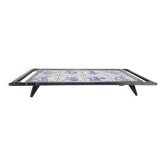
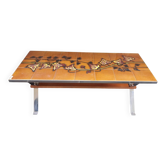
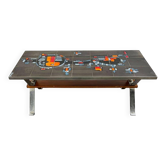
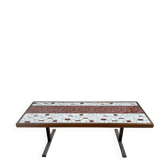
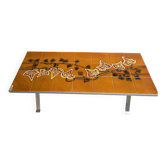
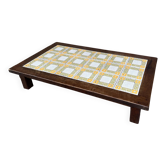
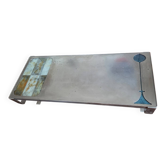
Warming tray/ceramic, silver/stainless steel, Germany/1970s.

- Dimensions :
- H4 x W31 x D55
- Color :
- multicolour
- Material :
- wood
- Style :
- mid-century
This original NEY warming tray from the 1960s or 1970s exemplifies European Mid-Century Modern functional design. Its rectangular shape and low, flat profile combine materials characteristic of the era: a dark, matte wood frame; cream-colored ceramic tiles featuring bold blue graphics in the style of Dutch Delftware; and a slender metal band—likely stainless steel—that highlights an industrial detail while reinforcing the structure. Short, angular legs integrated into the frame ensure stability and a geometric aesthetic. The heating element, complete with a power socket on one side, underscores the tray's functionality, allowing food or beverages to be kept warm during service. The surface retains its original artwork—free of cracks or chips—and the piece shows only minimal signs of use consistent with its age. It is in very good condition, with no evidence of restoration or major damage. Please note that the power cord is not included. This tray echoes the spirit of European modernism from the 1960s and 70s, where practicality meets decorative flair; the intricate ceramic tile graphics seem to tell stories of past gatherings, with each scene representing a chapter in the rituals of daily life. The blue-and-white illustrations—inspired by the Dutch Delft tradition—add a touch of classic charm, while the matte wood frame evokes the calm, cozy atmosphere of that bygone era. The subtle sheen of the metal and the ceramic pattern highlight the artisanal precision that was a hallmark of the era's design. The NEY warming tray can help create the atmosphere of a curated dining room or a living room with a retro touch. It serves perfectly as a table centerpiece when serving hot dishes at family gatherings or mid-century style evening parties. It pairs beautifully with blue or white porcelain, delicate cobalt-tinted glass, and the wood accents typical of the 1960s. It complements simple, geometric forms and works equally well as a decorative detail on a sideboard or credenza, .
Trays: other similar vintage pieces
Discover more similar items- -31%
- -50%
- -26%
- Sold out
- Sold out
- -35%
- -11%