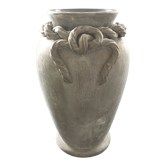
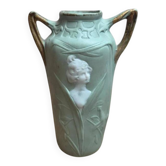
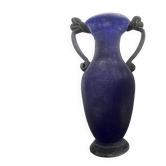
Outdoor vase / sculpture, HELMAN, Art Nouveau glazed stoneware, ca. 1900

- Dimensions :
- H51 x W25 x D26
- Color :
- multicolour
- Material :
- ceramics, porcelain and earthenware
- Style :
- art nouveau
Large double-handled amphora vase, Art Nouveau style, attributed to the Helman house, circa 1900. Made of glazed stoneware, without a base, which suggests outdoor use, allowing water to drain away in case of frost. Stoneware was commonly used at the time for landscaping parks and gardens. Very good original condition. Helman House - Célestin Helman (1863–1929): Célestin Joseph Helman, an architect and surveyor from the Verviers region, began his career working closely with the Manufacture de Céramiques Décoratives in Hasselt, where he was a shareholder and member of the management committee. He notably designed the firm's stand for the 1897 Brussels International Exhibition, which earned him a gold medal. In 1902, he founded his own company, first known as "Maison Helman Céramique d'Art", then "Helman Céramique" and "SA Helman Ceramic". His first workshop was established in Schaerbeek, before moving in 1906 to Berchem-Sainte-Agathe, along the Chaussée de Gand. Maison Helman became one of the great names in Art Nouveau ceramics in Brussels, alongside Guillaume Janssens (also in Berchem-Sainte-Agathe) and the Vermeren-Coché factory in Ixelles. These workshops, still pre-industrial, worked from models by painters. Helman tiles were exported as far as the United States. Alongside Art Nouveau tiles, Helman also produced large decorative scenes, such as the Deep Sea Fishing Scene from the Poissonnerie du Quartier Léopold (rue du Trône, Ixelles) and the decorations for the Rôtisserie Vincent (rue des Dominicains, Brussels). He also made ceramics for the Chinese Pavilion of Leopold II. The company grew to employ 160 workers and won gold medals at the Universal Exhibitions of Saint-Louis (1904) and Liège (1905). It collaborated with renowned designers such as Jacques Madiol (La fée électricité, La mère force motrice) and.
Vases: other similar vintage pieces
Discover more similar items- -12%
- -20%
- -23%
- Sold out
- -46%
- -49%
- -36%