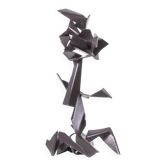
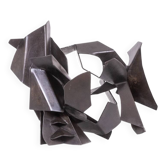
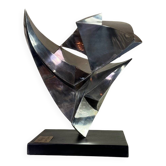
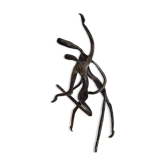
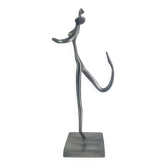
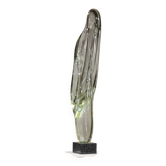
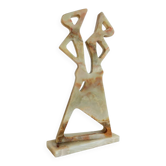
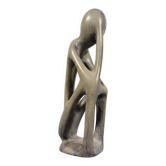
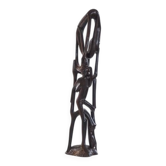
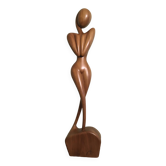
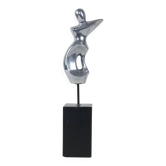
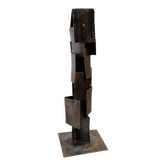
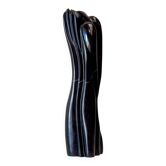
Albert Féraud, abstract sculpture, 1976, stainless steel

- Dimensions :
- H216 x W100 x D100
- Color :
- silver (Color)
- Material :
- linen
- Style :
- contemporary
Albert Féraud, born on 26 November 1921 in Paris and died on 11 January 2008 in Bagneux, was a French sculptor renowned for his innovative use of metallic materials, particularly stainless steel. After studying at the Écoles des beaux-arts in Montpellier, Marseille, and Paris, in the workshop of Alfred Janniot, Féraud won the first Grand Prix de Rome for sculpture in 1951. During the 1950s, he created numerous works in stone and bronze, including a series of busts that reflect the influence of sculptors such as Bourdelle and Despiau. The 1960s marked a turning point in his career: Féraud discovered reclaimed materials and turned towards abstraction. Alongside his sculptor friends César and Michel Guino, he salvaged materials from car wrecks and industrial dumps. After experimenting with lead, he moved on to welded iron, and then to stainless steel, becoming one of the pioneers of stainless steel sculpture after 1945. His work is characterised by entanglements of lyrical forms, composed of lines, twists, and arabesques, expressing great inventiveness. Despite an apparent exuberance, his works maintain an almost classical rigor, reflecting his sense of balance and harmony. Féraud held numerous exhibitions in France and abroad, notably in Basel, Zurich, Montreal, Lucerne, Frankfurt, Berlin, Warsaw, and Turin. His works are present in several public and private collections. In 1989, he was elected a member of the Académie des beaux-arts. He was also promoted to officer of the National Order of the Legion of Honour in 2002 and appointed a knight of the Order of Academic Palms in 1998.