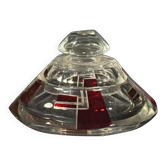
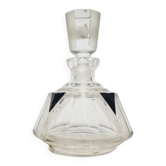
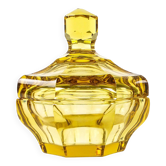
Art Deco bonbonniere, uranium crystal, Poland, 1930s

- Dimensions :
- H13 x W14 x D14
- Color :
- green
- Material :
- linen
- Style :
- art deco
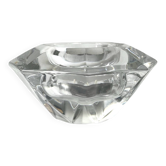
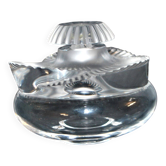
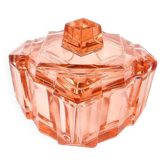
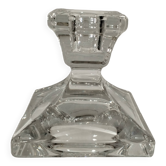
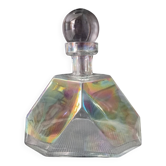
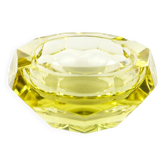
Art Deco uranium bonbonniere from Poland, 1930s, made of uranium glass with a characteristic semi-transparent light yellow-green hue. It features a shiny surface that enhances the crystal's luminosity, especially under UV light. The design is based on an architectural form with both the body and lid designed with geometrically stepped, ziggurat-like cuts. Sharp, linear facets create rhythmic, symmetrical patterns typical of the era. The thick, pressed crystal and beveled edges emphasize the item's solidity, while the absence of fittings or handles gives it a purely sculptural presence. The finishing details, especially the cuts on the lower edge, add expressiveness and depth. The condition is described as excellent: no chips or cracks, edges are intact, and the surface shows no signs of wear. This piece embodies the spirit of Polish Art Deco—a time when craftsmanship and modern architecture merged in a spectacular play of light and symmetry. Its geometric forms reflect the language of the 1930s: a period of growing urbanization and fascination with technological progress, even in everyday objects like this bonbonniere. The uranium glow of the glass evokes modernist interiors—sometimes almost futuristic, cool, yet precisely crafted. The changing shades of the bonbonniere refer to the dynamic atmosphere of the interwar period, highlighting both bold aesthetics and craftsmanship. The bonbonniere is best suited as an accent on a living room sideboard, dressing table, or console—whether in an Art Deco-styled space or in minimalist or collector's interiors, where it adds a touch of light and colour. It can be paired with chrome accessories, glass in contrasting colours (dark green, cobalt, violet), or a dark wooden background to enhance the luminous quality of the uranium glass. Surrounded by modernist graphics, geometric lamps, or mirrored elements, it achieves its full architectural expression; subtle lighting is recommended to bring out the fluorescence effect. Pairing with porcelain or simple ceramics will subtly emphasize its historical character.
Sweet boxes & sugar bowls: other similar vintage pieces
Discover more similar items- -10%
- -37%