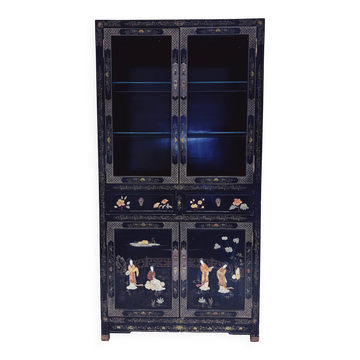
Pagoda-shaped cabinet, Chinese lacquer, early 20th century – China

- Dimensions :
- H210 x W110 x D33
- Color :
- multicolour
- Material :
- wood
- Style :
- world's craft
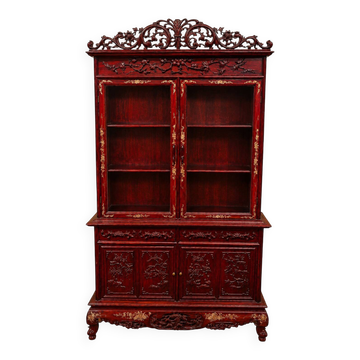
The showcase, cabinet, or bookshelf is in the shape of a pagoda of Chinese origin, made for export to Europe in the early 20th century. The piece, made of lacquered wood, rests on a metal base with four slender legs that elevate it. Above, three levels unfold, mimicking the structure of an Eastern pagoda. Its main body is divided into three sections. At the bottom, there are two small drawers with golden metal handles. The central part has two glass doors, with two shelves dividing the interior into three, where various objects or books can be displayed. The back, as well as the drawers, is lined with velvet. Finally, a roof crowns the cabinet, giving it its characteristic pagoda shape. The adaptation to Western taste is evident with the inclusion of features such as the handles and the bronze lock medallion in the Napoleon III style. The entire exterior is covered in lacquer, the front with hand-painted floral and geometric patterns in gold on the characteristic red background. The sides feature different scenes at various levels, with plant elements and figures in traditional costumes. These rich Eastern scenes, hand-painted on a glossy black lacquer background, are adorned with ivory and hard stones. Such motifs are common in Japanese and Chinese screens. Pagodas are temples of Chinese, Japanese, Korean, or Southeast Asian origin, all derived from Indian stupas. Although their ornamentation or style may vary, they always retain a similar basic structure: a tower with several stacked levels, each topped with roofs or overhangs, giving them their characteristic appearance. They primarily serve a religious function, acting as burial mounds in India, but in most Buddhist temples, they become places of veneration for Buddha statues, relics, or scriptures. The temple represents the connection between the earthly and celestial worlds, many ending with a metal spire.
China cabinets: other similar vintage pieces
Discover more similar items- -9%
- -18%
- -15%
- -17%
- Sold out