Stoneware vase Jean Pointu - St Amand en Puisaye

- Dimensions :
- H9 x W10 x D10
- Color :
- multicolour
- Material :
- ceramics, porcelain and earthenware
- Style :
- art nouveau
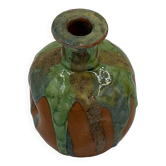
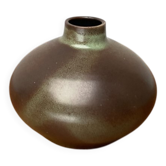
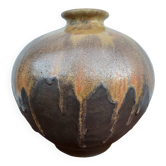
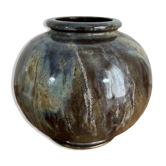
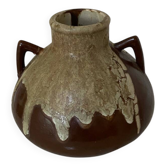
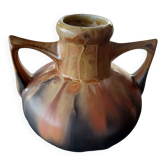
Very beautiful small glazed stoneware vase by Jean Pointu (1843-1925), made in Saint-Amand-en-Puisaye, Nièvre. With a flattened spherical shape and a small cylindrical neck, this piece presents a sober and perfectly balanced silhouette, inspired by Japanese aesthetics. Its remarkable glazing combines a deep, shiny violet-brown background with beautiful drips of glaze in shades of ochre and bronze. These layering effects, characteristic of Jean Pointu's explorations, create a natural and dynamic decoration that contrasts with the purity of the form. Jean Pointu (1843-1925) is an important figure in the School of Jean Carriès. After working in the Nevers region and then in Avon-Fontainebleau, he settled in 1906 in Saint-Amand-en-Puisaye at the age of 63. Influenced by Japonisme, he developed a production of artistic stoneware with refined shapes, favouring curved vases and layers of glazes with subtle effects. His work would have a lasting influence on that of his son Léon Pointu, also a ceramist. A major artist in the ceramics of Puisaye, Jean Pointu is referenced in the book "Grès de Puisaye, de Jean Carriès à nos jours – Marques et signatures, " dedicated to the potters and ceramists of the region. This piece is doubly signed, bearing the signature ".U" as well as the "P fleuri" mark, both characteristic of Jean Pointu. A beautiful collector's item, representative of the artistic stoneware of Puisaye from the early 20th century. Dimensions: Height: 9.5 cm. Diameter: 10.3 cm. Condition: perfect condition. Signature: double signature ".U" and "P fleuri." Origin: Saint-Amand-en-Puisaye, Nièvre, France. Period: around 1906-1915.