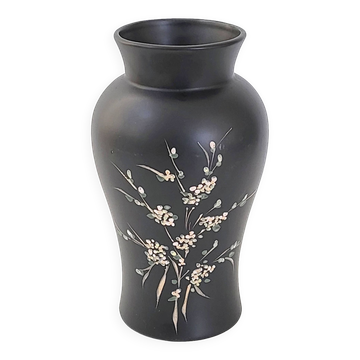
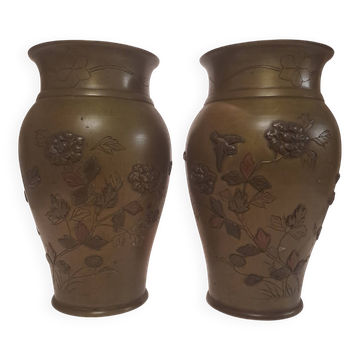
Japanese bronze vase, Shōwa era 1950/1970

Japanese vase with a sober cylindrical silhouette, a narrow neck, and a delicate decoration of flowering plum branches (ume). In Japanese culture, the plum tree is the first to bloom at the end of winter, symbolizing renewal, perseverance, and courage in the face of adversity. Origin: A very beautiful example of contemporary Japanese metal art (Shōwa or Heisei era). The slight golden signs of wear visible on the support ring reveal an alloy based on brass or light bronze (sentoku or yellow brass), covered with a speckled brown-black patina applied hot, inlaid with metals. This finish is characteristic of the artisanal production from the city of Takaoka (Toyama Prefecture), the main historical center of art metallurgy in Japan. Metal inlay technique: Once the vase is demolded, the artisan carves grooves into the bronze to hammer in threads of precious metals, creating contrasting patterns that emerge from the surface. The plum flowers and branches are delicately inlaid in soft relief. Distinct metallic shades can be distinguished (gold/brass for the flowers and copper/silver for the branches), according to the traditional metal inlay art (Hira-zōgan), a recognized specialty of the workshops in Kanazawa and Takaoka. The petals of the flowers subtly alternate between matte silver and gold reflections, typical of pieces intended for post-war art salons (1950s-1970s). Patina and finish: The surface features a matte brown-black patina that is subtly speckled, applied hot, typical of Japanese bronzes intended for floral art (ikebana) or understated interior decoration (tokonoma). Era: A characteristic vase of Takaoka's artisanal production (Toyama Prefecture). The clarity of the mechanical stamp and the regularity of the casting place this piece between the 1950s and 1970s. Signature: The rectangular seal engraved in the center reads 金峰 (Kinfō). This is the mark of the foundry artist Kinfō (sometimes written Kinfō saku, meaning "Made by Kinfō"), a master bronze artisan linked to the famous tradition of Takaoka brass. Condition: very good condition, with a visible trace on the patina, no material dents.
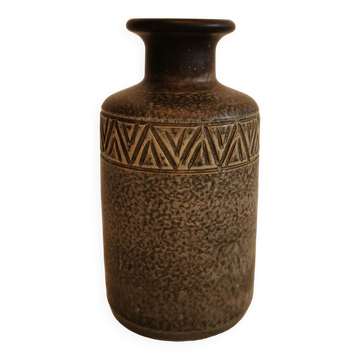
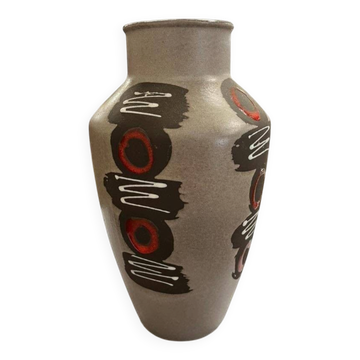
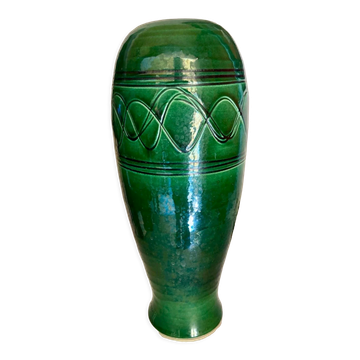
Vases: other similar vintage pieces
Discover more similar items- -20%
- -20%
- -15%
- -15%
- -20%
- -51%
- -18%
- -20%
- -35%
- -9%
- -20%
- -29%
- -8%
- -22%
- -20%
- -14%