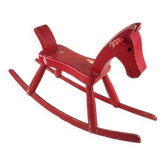
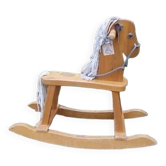
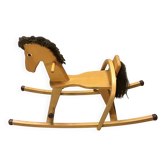
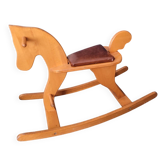
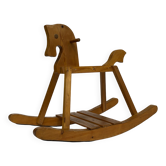
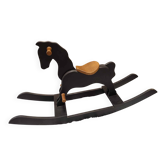
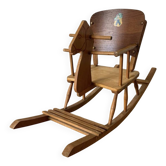
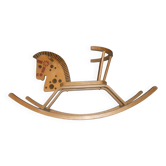
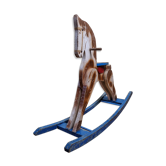
Kay Bojesen wooden rocking horse, Danish design toy from the 1970s

- Dimensions :
- H44 x W74 x D22
- Color :
- beige
- Material :
- wood
- Style :
- scandinavian
The Kay Bojesen rocking horse is one of the most recognisable Danish toys of the twentieth century. Produced in the 1970s, this wooden figure embodies the Scandinavian approach to children's design, where simplicity of form meets the warmth of natural materials. The piece maintains the characteristic balance between playful function and aesthetic value that defined Bojesen's work throughout his career. The construction features a stylised horse silhouette mounted on curved rockers that provide smooth, rhythmic movement. The form has been reduced to essential geometric shapes, capturing the essence of the animal without superfluous detail. Wooden elements combine beige and grey tones, creating the muted palette typical of Scandinavian design sensibility. Proportions were carefully considered for a child's ergonomics, while the stable base ensures safety during play. Kay Bojesen belongs to the generation of Danish designers who redefined toy-making in the twentieth century. Originally trained as a silversmith, he brought artisanal precision to his woodwork. His creations from the iconic monkey to wooden soldiers and this rocking horse merged functionalist principles with material warmth and gentle humour. Bojesen believed that a good toy should have a smile in its eyes, a philosophy evident in the friendly expressions of his wooden animals. His pieces became symbols of Danish design's ability to bring joy through thoughtful craftsmanship. This rocking horse serves equally well as a child's plaything or as a decorative object. The dimensions accommodate comfortable use by young children, while the timeless form makes it a fitting addition to a nursery or a living space furnished in mid-century modern style. Condition is good. Visible chips, scratches, and areas of discolouration on the wood surface indicate years of use. The more noticeable traces of use are also documented in the photographs, so that the actual state of preservation is conveyed as faithfully as possible.
4.93 ()
Decoration for kids: other similar vintage pieces
Discover more similar items- -19%
- -18%
- Sold out
- -12%
- -45%
- -29%
- -39%