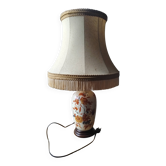
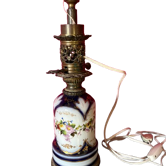
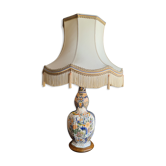
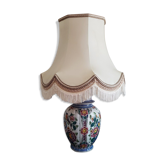
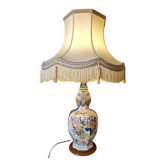
Porcelain Lamp by Samson, Famille Rose Style, 19th Century
This item has found its owner, but other one-of-a-kind items await you. 👇
Discover similar items- Dimensions :
- H80 x W22 x D22
- Color :
- multicolour
- Material :
- chrome
- Style :
- classic
Samson porcelain lamp in Chinese Famille Rose style, 19th century. Ginger jar vase with lid in Samson porcelain in Famille Rose style converted into a lamp. Polychrome decoration of flowers, foliage, branches, and vases, the ginger jar on a white background. Gilded bronze mount in Louis XV style with its original gilding. With its original lampshade, worn fabric but usable frame, topped with a gilded bronze flame. Louis XV style. Circa 1870. Famille Rose porcelains frequently feature polychrome decorations with floral and bouquet motifs, predominantly in pink tones. The decoration is applied on glaze, meaning after an initial firing of the porcelain covered with a transparent glaze. It is during a second firing, known as low fire (800°), that the colours are fixed. This type of decoration appeared during the reign of Emperor Yongzheng (1723-1736) and developed under Emperor Qianlong (1736-1796). Its origin is closely linked to the history of exchanges between East and West in the 17th and 18th centuries. Indeed, it was a Dutch chemist named Andreas Cassius who discovered in 1650 the chemical formula for producing pink glazes: this is the mineral purple, later called "Cassius purple, " a precipitate obtained from gold salt. China quickly acquired this formula - the purple became the "foreign colour" - and then used pink tones for porcelain intended for the domestic market but also, and especially, for export products.
Bedside and table lamps: other similar vintage pieces
Discover more similar items- -33%
- -36%
- -38%
- -12%
- -24%
- -25%
- -20%
- -34%