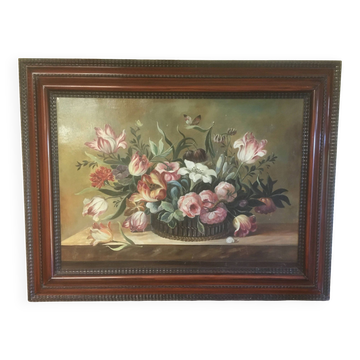
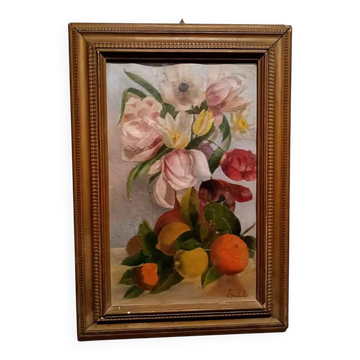
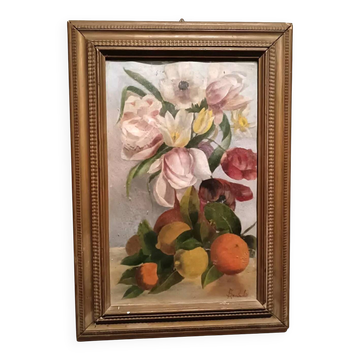
Ancient still life painting of summer fruits – Oil on wood circa 1900
This item has found its owner, but other one-of-a-kind items await you. 👇
Discover similar items- Dimensions :
- H34 x W60 x D6
- Color :
- multicolour
- Material :
- wood
- Style :
- classic
This ancient painting is fully in line with the tradition of still life, a major pictorial genre in the history of Western painting. Emerging as early as Antiquity but truly codified from the 17th century onwards, still life represents inanimate objects—fruits, flowers, tableware, everyday elements—not merely for their decorative beauty, but for what they convey about time, the abundance, the fragility of life, and the cycle of the seasons. Long regarded as an intellectual and symbolic genre, it experienced a true revival around 1900, at a time when bourgeois interiors sought decoration that was both elegant and reassuring, deeply connected to nature. By the end of the 19th century and the very beginning of the 20th century, still life gradually moved away from academic salons to enter homes. It became softer, more accessible, less demonstrative, while still maintaining a high level of technical mastery. Fruits, particularly summer fruits like peaches, occupy a central place, as they embody both maturity, the generosity of nature, and the idea of a suspended moment, that of the peak season. These paintings were often conceived in pairs, sometimes in triptychs, ideally in a series of the four seasons, with each work interacting with another to narrate the passage of time throughout the year. This painting, oil on wood, created around 1900, represents an allegory of summer, through a balanced composition blending sun-drenched fruits and delicate flowers. It was common at the time to hang them in a dining room or kitchen, the quintessential living spaces, where the painting interacted with daily life. Even today, this painting naturally finds its place in a kitchen, where it brings immediate visual warmth, a sense of a lived-in home, and an elegance without ostentation. The stucco frame typical of this period shows some signs of age, small losses and discreet wear that testify to its age and authenticity. Nothing is hidden, as these marks are an integral part of the object's history and contribute to its charm.
Antique paintings: other similar vintage pieces
Discover more similar items- Sold out
- -49%
- Sold out
- -13%
- -12%
- -9%
- -25%
- -17%
- -10%
- -12%