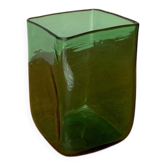
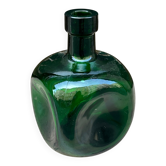
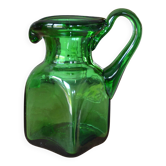
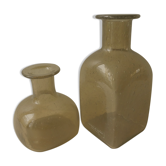
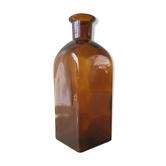
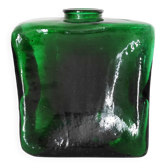
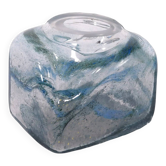
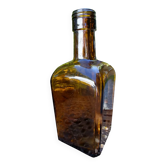
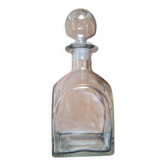
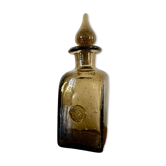
Mid-century modern glass form, olive glass, designed by M. Veltuzen-Nagrabecka, Poland, 1970s

- Dimensions :
- H19 x W9 x D17
- Color :
- green
- Material :
- linen
- Style :
- mid-century
A glass form designed by Maria Veltuzen-Nagrabecka, created in Poland in the 1970s, is a unique mid-century modern piece. It features an olive green colour with a warm, slightly yellowish hue. The glass is semi-transparent and distinguished by numerous small air bubbles evenly distributed within the mass. The shape refers to biomorphic experiments of the decade: its base is close to a cube, rounded at the edges, and above, the form transitions into a dynamically deformed, irregular shape reminiscent of crumpled or softly folded fabric. The opening is offset from the axis and gently pressed, emphasising the individuality of the object. The high-gloss surface reflects light in a wavy and irregular manner, revealing varying local glass thicknesses. The condition is excellent—no cracks, chips, repair marks, or modern interventions; natural inclusions in the glass are consistent with the artistic glassmaking technique of the period. This object signals the voice of the 1970s, full of courage in the search for organic shapes. Its asymmetrical line and irregular bubbles seem to tell the story of experiments at the glass furnace—fascination with movement, softness, and the unexpected dynamics of form. This glass not only rejects the convention of geometric discipline but also evokes the atmosphere of individual artistic work, where every impression in the mass and every irregularity shapes a unique character. The shine and varied texture of the glass contain the energy of the era's creative freedom; the object becomes a witness to artistic transformations and simultaneously a personal story of Maria Veltuzen-Nagrabecka. This form would work well as a solo accent on a low burnt oak console or against a graphite wall, where light will highlight its complex texture. It can be combined with fine studio ceramics or minimalist metal elements to bring out a dialogue of different textures and eras. Interiors in the spirit of collector's modernism or eclectic galleries—especially with a warm colour palette and soft, diffused light—will provide the optimal backdrop for this object. It is worth combining it with other examples of 1960s and 1970s glass to complete the atmosphere of sculptural freedom and experimentation.