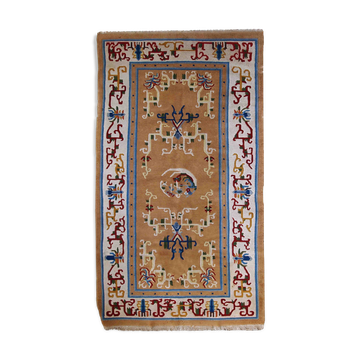
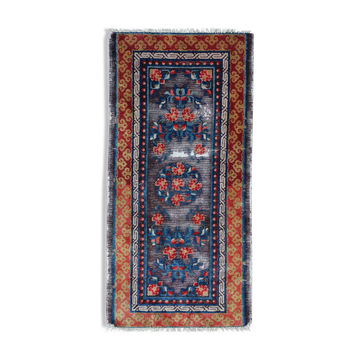
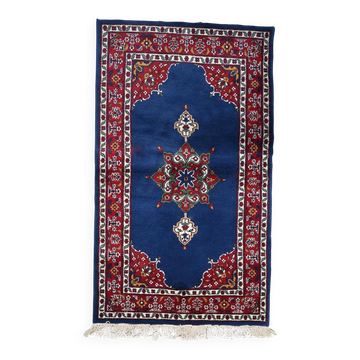
1900s Chinese PaoTao wool floral rug, blue & ivory, 2.33 × 4.40 ft - 1C1305

- Dimensions :
- H134 x W71 x D1
- Color :
- midnight blue
- Material :
- wool/cotton
- Style :
- world's craft
Handmade in China and dated to the early 1900s, this antique wool rug combines floral ornament with a geometric frame. Its deep midnight-blue field provides a dramatic background for flowering stems in layered blues and ivory. Measuring 71 × 134 cm, it has narrow rectangular proportions and a clearly balanced composition. The restrained palette allows the central flower, curling stems and angular corners to stand out without overwhelming the small format. An eight-pointed ivory flower forms the centre, surrounding a small blue heart. A stepped geometric outline encloses the flower, with fine ivory details defining its edges. Paired blossoms and curling leaves extend above and below the medallion. Larger flowering forms near each end give the arrangement a repeated rhythm, while open dark ground separates the individual motifs. Angular corner ornaments echo the stepped centre. Their pale-blue and ivory outlines connect the floral field to the surrounding border, creating a cohesive transition between curved and geometric shapes. A broad blue fretwork border frames the composition with diagonal lines and repeating angular forms. Narrow blue outlines and a delicate dotted band add further definition around the field. Ivory dots bring small points of brightness to the dark ground. The border’s repeated geometry contrasts with the softer curves of the flowering stems. Midnight blue, indigo, medium blue and pale blue create depth throughout the pattern. Ivory highlights sharpen the flower heads and geometric outlines, giving the design clarity at close range. The supplied construction is handmade and hand-knotted, using wool. Its compact footprint makes it an attractive accent beside a bed, in a study or within a small entrance area. The long format allows the paired floral arrangement to be appreciated as a complete composition. The early-1900s date is an approximate period attribution rather than a documented production year. Age-related surface wear is present, together with fraying at the ends and short, uneven fringe remnants. No restoration history has been supplied.
Contemporary rugs: other similar vintage pieces
Discover more similar items- -62%
- -72%
- -28%
- -15%