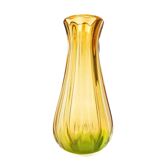
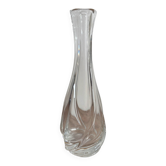
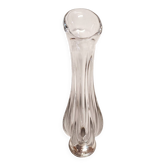
Sommerso vase, mid-century modern, glass, designed by F. Poli, Italy, 1950s

- Dimensions :
- H22 x W9 x D9
- Color :
- multicolour
- Material :
- glass and crystal
- Style :
- mid-century
The Murano Sommerso vase designed by Flavio Poli was made in Italy in the 1950s, representing a subtle example of mid-century modern in art glass. Made of thick, hand-formed glass, it features a soft silhouette with an elongated line, a distinctly rounded base, and a gently flared opening. The vase's surface shines with an intense, deep gloss; the dominant colour is warm amber, which subtly transitions to transparent green at the base. Characteristic of the sommerso technique, the colour layers blend in a noble tone, enriched by vertical, rhythmic grooves on the surface—a detail that enhances the dynamics of light and tactile impressions. The glass is free of visible joints, indicating the craftsmanship of hand production. There are no significant chips or cracks, and minimal signs of use attest to its exceptionally good condition. This type of vessel reflects the spirit of post-war Europe: clear glass and harmonious form convey the creative optimism of the 1950s. Murano, in Flavio Poli's interpretation, seems to tell of the search for light and new solutions—the colour swells inside the glass like a drop frozen in motion, and the soft curves of the form diffuse a gentle, warm glow. Every reflection and subtle shade change on the surface evokes the atmosphere of Italian craftsmanship—calm, yet open to experiment, full of harmony between tradition and modernity. The vase can be displayed on an oak console or marble top in the living room, where the play of colours and light will be enhanced by the proximity of natural materials. It fits perfectly into arrangements inspired by mid-century modern; it is worth pairing it with geometric ceramic vessels, minimalist lighting, or a single eucalyptus branch to highlight its glass layering. It can also serve as a focal point against a neutral wall or among books and vintage sculptures, emphasising the collector's character of the interior.