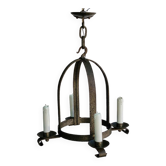
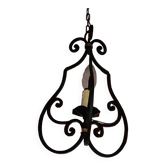
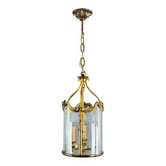
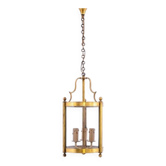
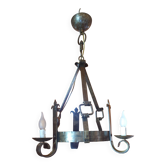
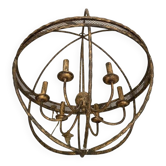
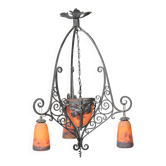
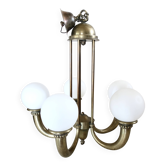
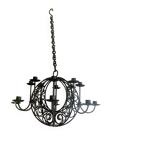
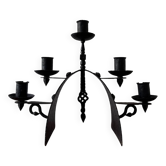
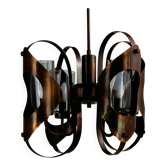
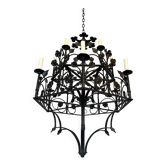
Wrought Iron Lantern, French Work, circa 1950

- Dimensions :
- H41 x W15 x D15
- Color :
- brown
- Material :
- iron
- Style :
- brutalist
Small in scale but accomplished in form, this wrought iron lantern — fifteen centimetres square and forty-one centimetres high — is part of the French tradition of domestic ironwork that furnished the staircases, corridors, and small courtyards of bourgeois interiors throughout the first half of the 20th century. At this size, the lantern is not designed as an architectural statement but as a companion to the human scale: a source of warm, directed light for a landing, a narrow corridor, or the corner of a small room where a more imposing light fixture would be excessive. Its square shape gives it a clarity of form that reads well against both bare plaster and elaborate woodwork. Wrought iron — metal shaped by hand under heat and with a hammer — has been used in French domestic interiors for centuries, and its continued production in the mid-20th century represents an important continuity in the face of industrialisation. Unlike cast iron, which takes the precise shape of a mould, wrought iron retains the slight irregularities and surface variations of handwork: no two pieces are ever quite identical. This lantern, made around 1950, was produced at a time when French artisans were still working in the traditional manner, using techniques passed down through generations of blacksmiths and locksmiths, before the economic pressures of the following decades definitively broke this continuity. The simplicity of this piece is in itself a sign of quality: no superfluous ornamentation, no added decoration, no surface treatment beyond the natural oxide of the iron. What remains is a form reduced to its essential elements — four posts, a roof, a glass panel, and the warm light that filters through it. Objects of this discretion are increasingly appreciated by collectors who recognise the integrity.